| dc.contributor.advisor | Aleksander Mądry. | en_US |
| dc.contributor.author | Tsipras, Dimitris | en_US |
| dc.contributor.other | Massachusetts Institute of Technology. Department of Electrical Engineering and Computer Science. | en_US |
| dc.date.accessioned | 2017-10-30T15:29:18Z | |
| dc.date.available | 2017-10-30T15:29:18Z | |
| dc.date.copyright | 2017 | en_US |
| dc.date.issued | 2017 | en_US |
| dc.identifier.uri | http://hdl.handle.net/1721.1/112050 | |
| dc.description | Thesis: S.M., Massachusetts Institute of Technology, Department of Electrical Engineering and Computer Science, 2017. | en_US |
| dc.description | Cataloged from PDF version of thesis. | en_US |
| dc.description | Includes bibliographical references (pages 61-65). | en_US |
| dc.description.abstract | In this thesis, we study matrix scaling and balancing, which are fundamental problems in scientific computing, with a long line of work on them that dates back to the 1960s. We provide algorithms for both these problems that, ignoring logarithmic factors involving the dimension of the input matrix and the size of its entries, both run in time Õ(m log K log² (1/[epsilon])) where e is the amount of error we are willing to tolerate. Here, K represents the ratio between the largest and the smallest entries of the optimal scalings. This implies that our algorithms run in nearly-linear time whenever K is quasi-polynomial, which includes, in particular, the case of strictly positive matrices. We complement our results by providing a separate algorithm that uses an interior-point method and runs in time Õ(m³/²(log log K + log(1/[epsilon]))), which becomes Õ(m³/² log(1/[epsilon])) for the case of matrix balancing and the doubly-stochastic variant of matrix scaling. In order to establish these results, we develop a new second-order optimization framework that enables us to treat both problems in a unified and principled manner. This framework identifies a certain generalization of linear system solving which we can use to efficiently minimize a broad class of functions, which we call second-order robust. We then show that in the context of the specific functions capturing matrix scaling and balancing, we can leverage and generalize the work on Laplacian system solving to make the algorithms obtained via this framework very efficient. This thesis is based on joint work with Michael B. Cohen, Aleksandr Mądry, and Adrian Vladu. | en_US |
| dc.description.statementofresponsibility | by Dimitrios Tsipras. | en_US |
| dc.format.extent | 77 pages | en_US |
| dc.language.iso | eng | en_US |
| dc.publisher | Massachusetts Institute of Technology | en_US |
| dc.rights | MIT theses are protected by copyright. They may be viewed, downloaded, or printed from this source but further reproduction or distribution in any format is prohibited without written permission. | en_US |
| dc.rights.uri | http://dspace.mit.edu/handle/1721.1/7582 | en_US |
| dc.subject | Electrical Engineering and Computer Science. | en_US |
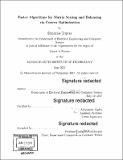
| dc.title | Faster algorithms for matrix scaling and balancing via convex optimization | en_US |
| dc.type | Thesis | en_US |
| dc.description.degree | S.M. | en_US |
| dc.contributor.department | Massachusetts Institute of Technology. Department of Electrical Engineering and Computer Science | |
| dc.identifier.oclc | 1006508897 | en_US |
| atmire.cua.enabled | Author's first name on title page should be Dimitris as confirmed by MIT Registrar June 2017 graduation list. | en_US |