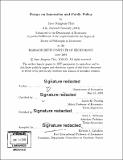
| dc.contributor.advisor | James M. Poterba and Heidi L. Williams. | en_US |
| dc.contributor.author | Choi, Jane Jungeun. | en_US |
| dc.contributor.other | Massachusetts Institute of Technology. Department of Economics. | en_US |
| dc.date.accessioned | 2019-09-16T20:57:46Z | |
| dc.date.available | 2019-09-16T20:57:46Z | |
| dc.date.copyright | 2019 | en_US |
| dc.date.issued | 2019 | en_US |
| dc.identifier.uri | https://hdl.handle.net/1721.1/122103 | |
| dc.description | Thesis: Ph. D., Massachusetts Institute of Technology, Department of Economics, 2019 | en_US |
| dc.description | Cataloged from PDF version of thesis. | en_US |
| dc.description | Includes bibliographical references (pages 143-148). | en_US |
| dc.description.abstract | Innovation is an important driver of economic growth, and public policy can affect many aspects of innovation. This thesis investigates the role of public policy in relation to two specific aspects of innovation: 1) who becomes an innovator and 2) where intellectual property is located once an innovation occurs. The first chapter analyzes how tax rates on patent- and trademark-related income affect where patents and trademarks are located internationally. I study how changes in patent and trademark tax rates in various countries altered the flow of patents and trademarks in and out of the countries. Using data on patent and trademark transfers from the US Patent & Trademark Office (USPTO), combined with market-based patent value estimates, I estimate the sensitivity of IP location to the changes in tax rates. I present suggestive evidence of income shifting and tax base erosion by showing that patents and trademarks tend to locate in countries with lower tax rates. The second chapter (jointly written with Carolyn Stein and Heidi Williams) investigates the role of gender in the evaluation of patent applications submitted to the USPTO. We document that patent examiner gender appears to have no effect on the evaluation of patent applications submitted by female inventors relative to male inventors, suggesting male examiners are not differentially biased in their evaluation of patent applications from female inventors. The third chapter (jointly written with Yosub Jung) investigates how the passage of US state laws granting married women the rights to own separate property and own their earnings affected patenting by female inventors. In the 1800s, before such laws were passed, the notion of coverture meant that married women's property and earnings were controlled by their husbands. We compare patenting by women before and after the acts and show that patenting by women increased after these laws. | en_US |
| dc.description.statementofresponsibility | by Jane Jungeun Choi. | en_US |
| dc.format.extent | 148 pages | en_US |
| dc.language.iso | eng | en_US |
| dc.publisher | Massachusetts Institute of Technology | en_US |
| dc.rights | MIT theses are protected by copyright. They may be viewed, downloaded, or printed from this source but further reproduction or distribution in any format is prohibited without written permission. | en_US |
| dc.rights.uri | http://dspace.mit.edu/handle/1721.1/7582 | en_US |
| dc.subject | Economics. | en_US |
| dc.title | Essays on innovation and public policy | en_US |
| dc.type | Thesis | en_US |
| dc.description.degree | Ph. D. | en_US |
| dc.contributor.department | Massachusetts Institute of Technology. Department of Economics | en_US |
| dc.identifier.oclc | 1119389081 | en_US |
| dc.description.collection | Ph.D. Massachusetts Institute of Technology, Department of Economics | en_US |
| dspace.imported | 2019-09-16T20:57:41Z | en_US |
| mit.thesis.degree | Doctoral | en_US |
| mit.thesis.department | Econ | en_US |