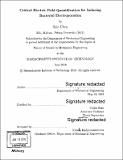
| dc.contributor.advisor | Cullen Buie. | en_US |
| dc.contributor.author | Chen, Sijie. | en_US |
| dc.contributor.other | Massachusetts Institute of Technology. Department of Mechanical Engineering. | en_US |
| dc.date.accessioned | 2019-09-16T21:16:59Z | |
| dc.date.available | 2019-09-16T21:16:59Z | |
| dc.date.copyright | 2019 | en_US |
| dc.date.issued | 2019 | en_US |
| dc.identifier.uri | https://hdl.handle.net/1721.1/122149 | |
| dc.description | Thesis: S.M., Massachusetts Institute of Technology, Department of Mechanical Engineering, 2019 | en_US |
| dc.description | Cataloged from PDF version of thesis. | en_US |
| dc.description | Includes bibliographical references (pages 61-69). | en_US |
| dc.description.abstract | Electroporation is one of the most popular methods for rapid and efficient intracellular transport of foreign molecules, such as peptides, drugs, and DNA, and is crucial for applications in genetic engineering. However, there is still a lack of mechanistic understanding of electroporation, and the most common method to optimize electroporation parameters for bacterial genetic transformation is still based on trial and error. In this work, to alleviate this issue we use microfluidic techniques to achieve rapid screening of electric fields for electroporation in live bacteria. To determine the critical electric field required for inducing bacterial electroporation, we extend upon a previously developed microfluidic assay. By quantifying the critical electric field values of gram-positive bacteria Corynebacterium glutamicum and Bacillus subtilis 168, and the gram-negative bacteria Escherichia coli BL21 (DE3) and Pseudomonas syringae ESC 10 in 10% glycerol and 0.01 x PBS, we study the effects of using different buffer solutions for different bacteria in the electroporation process. We also investigate the relationship between cell polarizability and critical electric field for these cells in the aforementioned buffer solutions. Next, we discuss the accuracy of the measurement by illuminating how undesired phenomena such as electroosmosis and electrophoresis contribute to the measurement error. Results of this study will enhance our understanding of the electroporation process and provide insights in discovering and optimizing electroporation protocols. | en_US |
| dc.description.statementofresponsibility | by Sijie Chen. | en_US |
| dc.format.extent | 69 pages | en_US |
| dc.language.iso | eng | en_US |
| dc.publisher | Massachusetts Institute of Technology | en_US |
| dc.rights | MIT theses are protected by copyright. They may be viewed, downloaded, or printed from this source but further reproduction or distribution in any format is prohibited without written permission. | en_US |
| dc.rights.uri | http://dspace.mit.edu/handle/1721.1/7582 | en_US |
| dc.subject | Mechanical Engineering. | en_US |
| dc.title | Critical electric field quantification for inducing bacterial electroporation | en_US |
| dc.type | Thesis | en_US |
| dc.description.degree | S.M. | en_US |
| dc.contributor.department | Massachusetts Institute of Technology. Department of Mechanical Engineering | en_US |
| dc.identifier.oclc | 1117714645 | en_US |
| dc.description.collection | S.M. Massachusetts Institute of Technology, Department of Mechanical Engineering | en_US |
| dspace.imported | 2019-09-16T21:16:57Z | en_US |
| mit.thesis.degree | Master | en_US |
| mit.thesis.department | MechE | en_US |