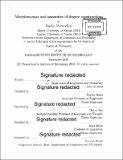
| dc.contributor.advisor | Martin Hackl, Danny Fox, and Irene Heim. | en_US |
| dc.contributor.author | Moracchini, Sophie,Ph. D.Massachusetts Institute of Technology. | en_US |
| dc.contributor.other | Massachusetts Institute of Technology. Department of Linguistics and Philosophy. | en_US |
| dc.date.accessioned | 2020-03-09T18:53:14Z | |
| dc.date.available | 2020-03-09T18:53:14Z | |
| dc.date.copyright | 2019 | en_US |
| dc.date.issued | 2019 | en_US |
| dc.identifier.uri | https://hdl.handle.net/1721.1/124094 | |
| dc.description | Thesis: Ph. D. in Linguistics, Massachusetts Institute of Technology, Department of Linguistics and Philosophy, 2019 | en_US |
| dc.description | Cataloged from PDF version of thesis. | en_US |
| dc.description | Includes bibliographical references (pages 183-188). | en_US |
| dc.description.abstract | This thesis investigates the morphosyntax and the semantics of comparatives and related degree constructions through the prism of a phenomenon called evaluativity, a type of inference whereby gradable adjectives receive a context-dependent interpretation. Pursuing the view that evaluativity is contributed by an optional null operator (EVAL, Rett 2008), this dissertation achieves the following results. First, it integrates a compositional analysis of evaluativity within a non-lexical view of antonymy. Second, it argues that the observed restrictions on the distribution of these inferences follow from independently motivated conditions that regulate the presence of the EVAL operator at the interfaces. In particular, three interface conditions are identified and discussed in detail: ++ At Logical Form (LF), derivations are subject to a structural economy condition, Minimize APs!, which executes transderivational comparisons over semantically equivalent Adjectival Phrases (APs). | en_US |
| dc.description.abstract | The inclusion of EVAL in a parse licenses derivations that would otherwise be deemed deviant by this economy condition. ++ At Phonological Form (PF), the EVAL morpheme morphophonologically interacts with its surrounding environment. Specifically, EVAL is claimed to be a zero-morpheme subject to Myers Generalization, a PF-filter on syntactic derivations which prevents further morphological operations from applying to a zeroderived form. A consequence of this claim is that EVAL is licensed in derivations only where it does not disrupt post-syntactic operations that apply within the AP. ++ The distribution of EVAL is conditioned by aspects of Information Structure. In particular, in degree constructions that license contrastive adjectives, the distribution of focus is governed by (AvoIDF) which, in turn, interacts with conditions on deletion. Ultimately, the presence of EVAL can license a surface form which would otherwise get eliminated by PF-deletion. | en_US |
| dc.description.abstract | In essence, the grammatical account of evaluativity developed in this thesis offers a window into the word-internal structure of complex degree expressions and presents new insights into the semantic and morphosyntactic primitives of the degree domain. | en_US |
| dc.description.statementofresponsibility | by Sophie Moracchini. | en_US |
| dc.format.extent | 188 pages | en_US |
| dc.language.iso | eng | en_US |
| dc.publisher | Massachusetts Institute of Technology | en_US |
| dc.rights | MIT theses are protected by copyright. They may be viewed, downloaded, or printed from this source but further reproduction or distribution in any format is prohibited without written permission. | en_US |
| dc.rights.uri | http://dspace.mit.edu/handle/1721.1/7582 | en_US |
| dc.subject | Linguistics and Philosophy. | en_US |
| dc.title | Morphosyntax and semantics of degree constructions | en_US |
| dc.type | Thesis | en_US |
| dc.description.degree | Ph. D. in Linguistics | en_US |
| dc.contributor.department | Massachusetts Institute of Technology. Department of Linguistics and Philosophy | en_US |
| dc.identifier.oclc | 1142633803 | en_US |
| dc.description.collection | Ph.D.inLinguistics Massachusetts Institute of Technology, Department of Linguistics and Philosophy | en_US |
| dspace.imported | 2020-03-09T18:53:13Z | en_US |
| mit.thesis.degree | Doctoral | en_US |
| mit.thesis.department | Ling | en_US |