The MIT Libraries is completing a major upgrade to DSpace@MIT.
Starting May 5 2026, DSpace will remain functional, viewable, searchable, and downloadable, however, you will not be able to edit existing collections or add new material.
We are aiming to have full functionality restored by May 18, 2026, but intermittent service interruptions may occur.
Please email dspace-lib@mit.edu with any questions.
Thank you for your patience as we implement this important upgrade.
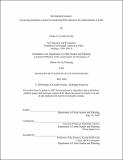
Development inequity : advancing distributive justice by localizing SDG indicators for municipalities in Chile
| dc.contributor.advisor | Gabriella Carolini. | en_US |
| dc.contributor.author | Castillo Peredo, Diego H.(Diego Hernán) | en_US |
| dc.contributor.other | Massachusetts Institute of Technology. Department of Urban Studies and Planning. | en_US |
| dc.coverage.spatial | s-cl--- | en_US |
| dc.date.accessioned | 2020-09-15T22:04:54Z | |
| dc.date.available | 2020-09-15T22:04:54Z | |
| dc.date.copyright | 2020 | en_US |
| dc.date.issued | 2020 | en_US |
| dc.identifier.uri | https://hdl.handle.net/1721.1/127583 | |
| dc.description | Thesis: M.C.P., Massachusetts Institute of Technology, Department of Urban Studies and Planning, May, 2020 | en_US |
| dc.description | Cataloged from the official PDF of thesis. | en_US |
| dc.description | Includes bibliographical references (pages 101-110). | en_US |
| dc.description.abstract | Through examining the Sustainable Development Goals (SDGs) at a municipal scale in Chile, this thesis demonstrates that localizing the development agenda is required for advancing distributive justice in the country. Because the mainstream development narrative suffers from contradictions similar to those of the discourse of Chile's economic progress, the SDGs are expected to be insufficient for revealing inequities, which compromises their own goal of "leaving no one behind." Despite the improvements in poverty reduction and access to basic services, three conditions suggest significant distributional and spatial equity concerns: the heterogenic conditions among Chilean municipalities; the presence of a unitary and centralized government; and the high dependence on economic factors of the local capacities for advancing development. However, the localization of the 2030 Agenda presents an opportunity for elevating local conditions and balancing national and local capacities. | en_US |
| dc.description.abstract | Through the disaggregation of eleven SDG indicators, this research analyzes the development performance of municipalities based on their internal dispersion and precision, spatial distribution, and correlation with sociodemographic and economic characteristics. Data is obtained from publicly accessible sources used by the country to calculate its official statistics and progress reports. Using a resource-based and capabilities approach on distributive justice, the quantitative analysis serves to assess to what extent localization can help advance spatial equity. The results show that aggregates can be deceiving, concealing significant local variation and masking important deficiencies, and that the lowest-performing areas are biased toward rural, satellite, less-accessible, and resource-scarce municipalities. These findings support the need for localizing development agendas to subnational scales as a way of promoting distributive and spatial justice. | en_US |
| dc.description.abstract | Moreover, increasing the resources and the agency of municipalities to take action upon their own development is also necessary to advance distributive justice. This analysis underscores the limitations of the SDG framework in exposing less developed areas within the country and their shortcomings in advocating for an appropriate narrative of development. As their adoption and influence increase, this research contributes to expand knowledge on how to operationalize them for advancing sustainable development with equity. | en_US |
| dc.description.statementofresponsibility | by Diego H. Castillo Peredo. | en_US |
| dc.format.extent | 110 pages | en_US |
| dc.language.iso | eng | en_US |
| dc.publisher | Massachusetts Institute of Technology | en_US |
| dc.rights | MIT theses may be protected by copyright. Please reuse MIT thesis content according to the MIT Libraries Permissions Policy, which is available through the URL provided. | en_US |
| dc.rights.uri | http://dspace.mit.edu/handle/1721.1/7582 | en_US |
| dc.subject | Urban Studies and Planning. | en_US |
| dc.title | Development inequity : advancing distributive justice by localizing SDG indicators for municipalities in Chile | en_US |
| dc.title.alternative | Advancing distributive justice by localizing SDG indicators for municipalities in Chile | en_US |
| dc.type | Thesis | en_US |
| dc.description.degree | M.C.P. | en_US |
| dc.contributor.department | Massachusetts Institute of Technology. Department of Urban Studies and Planning | en_US |
| dc.identifier.oclc | 1193555589 | en_US |
| dc.description.collection | M.C.P. Massachusetts Institute of Technology, Department of Urban Studies and Planning | en_US |
| dspace.imported | 2020-09-15T22:04:53Z | en_US |
| mit.thesis.degree | Master | en_US |
| mit.thesis.department | UrbStud | en_US |