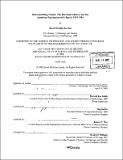
| dc.contributor.advisor | Merritt Roe Smith. | en_US |
| dc.contributor.author | Lucsko, David Nicholas | en_US |
| dc.contributor.other | Massachusetts Institute of Technology. Program in Science, Technology and Society. | en_US |
| dc.date.accessioned | 2007-10-19T20:26:57Z | |
| dc.date.available | 2007-10-19T20:26:57Z | |
| dc.date.copyright | 2005 | en_US |
| dc.date.issued | 2005 | en_US |
| dc.identifier.uri | http://hdl.handle.net/1721.1/39177 | |
| dc.description | Thesis (Ph. D. in History and Social Study of Science and Technology (HASTS))--Massachusetts Institute of Technology, Program in Science, Technology and Society, 2005. | en_US |
| dc.description | Includes bibliographical references (v. 2, p. 426-437). | en_US |
| dc.description.abstract | This dissertation focuses on the pursuits of a particular subset of automobile users: hot rodders, those who modify their standard production automobiles for improved performance. More specifically, this project examines the history of the speed equipment industry - the aftermarket subsector which manufactures high-performance products for hot rodders - from its infancy in the 1910s through the mid 1980s. The thesis begins by examining the role of technological enthusiasm in the early growth of hot rodding, focusing in particular on the ways in which this enthusiasm led a handful of individuals to begin to manufacture high-performance parts in the 1910s, 1920s, and 1930s. After tracing the wartime experiences of these industry pioneers, the project then explores the ways in which, in the midst of America's postwar affluence, the spectacular growth both of the high-performance industry and of hot rodding itself helped spawn the youth-oriented musclecar movement upon which the Big Three would later feed. In its examination of the 1940s and 1950s, the dissertation closely examines the evolution of this industry's production methods in an attempt to understand the manufacturing dynamics of a market-sensitive, flexibly-oriented, late-twentieth-century industrial sector. | en_US |
| dc.description.abstract | (cont.) The thesis then explores the ways in which this industry dealt with automotive safety and environmental legislation in the 1960s and 1970s. It concludes with a discussion of the fragmentation of the hot rod market during the 1970s and 1980s, analyzing the manufacturing and marketing challenges this change has wrought. This project sheds new light on the history of the automobile in America in four main ways. It highlights the survival of a flexibly-oriented, consumer-driven automotive industry in the shadow of the Big Three. It emphasizes the lingering importance of technological enthusiasm in the evolution of automobility. It uses the experience of the speed equipment industry to reexamine and revise our understanding of the relationship between the Big Three and governmental regulators. And, finally, it challenges the longstanding notion that the automobile had become a 'black box' by the 1920s, documenting the extent to which the social constructivists' 'end-user interpretive flexibility' has instead remained quite strong throughout the history of the automobile. | en_US |
| dc.description.statementofresponsibility | by David Nicholas Lucsko. | en_US |
| dc.format.extent | 2 v. (437 p.) | en_US |
| dc.language.iso | eng | en_US |
| dc.publisher | Massachusetts Institute of Technology | en_US |
| dc.rights | M.I.T. theses are protected by copyright. They may be viewed from this source for any purpose, but reproduction or distribution in any format is prohibited without written permission. See provided URL for inquiries about permission. | en_US |
| dc.rights.uri | http://dspace.mit.edu/handle/1721.1/7582 | |
| dc.subject | Program in Science, Technology and Society. | en_US |
| dc.title | Manufacturing muscle : the hot rod industry and the American fascination with speed, 1915-1984 | en_US |
| dc.type | Thesis | en_US |
| dc.description.degree | Ph.D.in History and Social Study of Science and Technology (HASTS | en_US |
| dc.contributor.department | Massachusetts Institute of Technology. Program in Science, Technology and Society | |
| dc.identifier.oclc | 62715897 | en_US |