| dc.contributor.advisor | James M. Poterba and William C. Wheaton. | en_US |
| dc.contributor.author | Shan, Hui, Ph. D. Massachusetts Institute of Technology | en_US |
| dc.contributor.other | Massachusetts Institute of Technology. Dept. of Economics. | en_US |
| dc.date.accessioned | 2008-12-11T16:55:12Z | |
| dc.date.available | 2008-12-11T16:55:12Z | |
| dc.date.copyright | 2008 | en_US |
| dc.date.issued | 2008 | en_US |
| dc.identifier.uri | http://hdl.handle.net/1721.1/43728 | |
| dc.description | Thesis (Ph. D.)--Massachusetts Institute of Technology, Dept. of Economics, 2008. | en_US |
| dc.description | This electronic version was submitted by the student author. The certified thesis is available in the Institute Archives and Special Collections. | en_US |
| dc.description | Includes bibliographical references. | en_US |
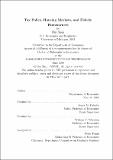
| dc.description.abstract | This dissertation consists of three essays studying the impact of tax policy on housing markets and elderly homeowners. Chapter One examines the potential lock-in effect of capital gains taxation on home sales, using the Taxpayer Relief Act of 1997 (TRA97) as a policy instrument. Before 1997, homeowners were subject to capital gains taxation when they sold their houses unless they purchased replacement homes of equal or greater value. Since 1997, homeowners can exclude $500,000 of capital gains when they sell their houses. Using zip-code level housing price indices and sales data from 1982 to 2006 on single-family houses in 16 affluent towns within the Boston metropolitan area, I find that TRA97 reversed the lock-in effect for houses with low and moderate capital gains. However, the semiannual home sale rate of houses with capital gains above $500,000 declined after TRA97, suggesting that TRA97 generated an unintended lock-in effect for houses with capital gains over the maximum exclusion amount. Chapter Two studies the relationship between property taxes and elderly mobility. This is the first study using an instrumental variable approach to address the endogeneity problem associated with property taxes in analyzing elderly mobility. Using household-level panel data from the Health and Retirement Study (HRS) and a newly-collected dataset on state-provided property tax relief programs, I find evidence suggesting that higher property taxes raise mobility rates among elderly homeowners. Eligibility for relief programs lowers mobility rates, and the impact of these programs appears to vary with program types, program generosity, and implementation strategy. | en_US |
| dc.description.abstract | (cont.) Chapter Three investigates the effect of property taxes on elderly homeowners labor supply decisions, using similar data and empirical strategy employed in Chapter Two. I examine both the extensive margin - whether elderly homeowners' delay retirement or reenter the labor force in the face of rising property taxes, and the intensive margin - whether elderly homeowners work longer hours when property taxes increase. I find little evidence that property taxes have a significant impact on elderly labor supply. | en_US |
| dc.description.statementofresponsibility | Hui Shan. | en_US |
| dc.format.extent | 169 p. | en_US |
| dc.language.iso | eng | en_US |
| dc.publisher | Massachusetts Institute of Technology | en_US |
| dc.rights | M.I.T. theses are protected by
copyright. They may be viewed from this source for any purpose, but
reproduction or distribution in any format is prohibited without written
permission. See provided URL for inquiries about permission. | en_US |
| dc.rights.uri | http://dspace.mit.edu/handle/1721.1/7582 | en_US |
| dc.subject | Economics. | en_US |
| dc.title | Tax policy, housing markets, and elderly homeowners | en_US |
| dc.type | Thesis | en_US |
| dc.description.degree | Ph.D. | en_US |
| dc.contributor.department | Massachusetts Institute of Technology. Department of Economics | |
| dc.identifier.oclc | 259746581 | en_US |