| dc.contributor.advisor | James R. Glass and Stephanie Seneff. | en_US |
| dc.contributor.author | Choueiter, Ghinwa F., 1980- | en_US |
| dc.contributor.other | Massachusetts Institute of Technology. Dept. of Electrical Engineering and Computer Science. | en_US |
| dc.date.accessioned | 2009-08-26T17:03:16Z | |
| dc.date.available | 2009-08-26T17:03:16Z | |
| dc.date.copyright | 2008 | en_US |
| dc.date.issued | 2009 | en_US |
| dc.identifier.uri | http://hdl.handle.net/1721.1/46610 | |
| dc.description | Thesis (Ph. D.)--Massachusetts Institute of Technology, Dept. of Electrical Engineering and Computer Science, 2009. | en_US |
| dc.description | Includes bibliographical references (p. 173-185). | en_US |
| dc.description.abstract | Despite the proliferation of speech-enabled applications and devices, speech-driven human-machine interaction still faces several challenges. One of theses issues is the new word or the out-of-vocabulary (OOV) problem, which occurs when the underlying automatic speech recognizer (ASR) encounters a word it does not "know". With ASR being deployed in constantly evolving domains such as restaurant ratings, or music querying, as well as on handheld devices, the new word problem continues to arise.This thesis is concerned with the OOV problem, and in particular with the process of modeling and learning the lexical properties of an OOV word through a linguistically-motivated sub-syllabic model. The linguistic model is designed using a context-free grammar which describes the sub-syllabic structure of English words, and encapsulates phonotactic and phonological constraints. The context-free grammar is supported by a probability model, which captures the statistics of the parses generated by the grammar and encodes spatio-temporal context. The two main outcomes of the grammar design are: (1) sub-word units, which encode pronunciation information, and can be viewed as clusters of phonemes; and (2) a high-quality alignment between graphemic and sub-word units, which results in hybrid entities denoted as spellnemes. The spellneme units are used in the design of a statistical bi-directional letter-to-sound (L2S) model, which plays a significant role in automatically learning the spelling and pronunciation of a new word.The sub-word units and the L2S model are assessed on the task of automatic lexicon generation. In a first set of experiments, knowledge of the spelling of the lexicon is assumed. It is shown that the phonemic pronunciations associated with the lexicon can be successfully learned using the L2S model as well as a sub-word recognizer. | en_US |
| dc.description.abstract | (cont.) In a second set of experiments, the assumption of perfect spelling knowledge is relaxed, and an iterative and unsupervised algorithm, denoted as Turbo-style, makes use of spoken instances of both spellings and words to learn the lexical entries in a dictionary.Sub-word speech recognition is also embedded in a parallel fashion as a backoff mechanism for a word recognizer. The resulting hybrid model is evaluated in a lexical access application, whereby a word recognizer first attempts to recognize an isolated word. Upon failure of the word recognizer, the sub-word recognizer is manually triggered. Preliminary results show that such a hybrid set-up outperforms a large-vocabulary recognizer.Finally, the sub-word units are embedded in a flat hybrid OOV model for continuous ASR. The hybrid ASR is deployed as a front-end to a song retrieval application, which is queried via spoken lyrics. Vocabulary compression and open-ended query recognition are achieved by designing a hybrid ASR. The performance of the frontend recognition system is reported in terms of sentence, word, and sub-word error rates. The hybrid ASR is shown to outperform a word-only system over a range of out-of-vocabulary rates (1%-50%). The retrieval performance is thoroughly assessed as a fmnction of ASR N-best size, language model order, and the index size. Moreover, it is shown that the sub-words outperform alternative linguistically-motivated sub-lexical units such as phonemes. Finally, it is observed that a dramatic vocabulary compression - by more than a factor of 10 - is accompanied by a minor loss in song retrieval performance. | en_US |
| dc.description.statementofresponsibility | by Ghinwa F. Choueiter. | en_US |
| dc.format.extent | 185 p. | en_US |
| dc.language.iso | eng | en_US |
| dc.publisher | Massachusetts Institute of Technology | en_US |
| dc.rights | M.I.T. theses are protected by
copyright. They may be viewed from this source for any purpose, but
reproduction or distribution in any format is prohibited without written
permission. See provided URL for inquiries about permission. | en_US |
| dc.rights.uri | http://dspace.mit.edu/handle/1721.1/7582 | en_US |
| dc.subject | Electrical Engineering and Computer Science. | en_US |
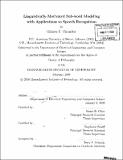
| dc.title | Linguistically-motivated sub-word modeling with applications to speech recognition | en_US |
| dc.type | Thesis | en_US |
| dc.description.degree | Ph.D. | en_US |
| dc.contributor.department | Massachusetts Institute of Technology. Department of Electrical Engineering and Computer Science | |
| dc.identifier.oclc | 426039187 | en_US |