The MIT Libraries is completing a major upgrade to DSpace@MIT.
Starting May 5 2026, DSpace will remain functional, viewable, searchable, and downloadable, however, you will not be able to edit existing collections or add new material.
We are aiming to have full functionality restored by May 18, 2026, but intermittent service interruptions may occur.
Please email dspace-lib@mit.edu with any questions.
Thank you for your patience as we implement this important upgrade.
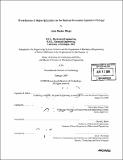
The influence of higher education on the national innovation system in Portugal
| dc.contributor.advisor | Christopher Magee. | en_US |
| dc.contributor.author | Ringo, John Decker | en_US |
| dc.contributor.other | Massachusetts Institute of Technology. Dept. of Mechanical Engineering. | en_US |
| dc.coverage.spatial | e-po--- | en_US |
| dc.date.accessioned | 2010-03-25T14:55:11Z | |
| dc.date.available | 2010-03-25T14:55:11Z | |
| dc.date.copyright | 2009 | en_US |
| dc.date.issued | 2009 | en_US |
| dc.identifier.uri | http://hdl.handle.net/1721.1/53061 | |
| dc.description | Thesis (S.M. in Technology and Policy)--Massachusetts Institute of Technology, Engineering Systems Division, Technology and Policy Program; and, (S.M.)--Massachusetts Institute of Technology, Dept. of Mechanical Engineering, 2009. | en_US |
| dc.description | Includes bibliographical references (p. 75-79). | en_US |
| dc.description.abstract | Many economists agree that countries wishing to develop their national economies should focus on increasing their innovation output. In recent years, the Portuguese government has pursued this goal, taking strides to improve the country's national system of innovation. This effort has included policy measures to increase the educational attainment of the Portuguese population and to improve the amount of collaboration between academia and industry in Portugal. Prior studies of locational effects have concluded that universities have a positive effect on the innovation output of the regions in which they are located. However, there is little understanding of how this locational effect varies with alternative types of higher education institutions, such as polytechnics and community colleges. This thesis evaluates the co-locational effects of educational institutions and industry clusters on innovation output, and makes recommendations for how these results may be put to use, given the historical context of the Portuguese higher education system. The analysis is a comparative study of the geographic sub-regions within Portugal and the U.S. states of Georgia and Pennsylvania. The data used in the analysis includes industry data (enterprises, employment, and wages), educational data (number of graduates by field and type of institution), and innovation survey data. The result of the co-location analysis shows that in Portugal, the technology-focused courses at universities and polytechnics are not concentrated in the same region as technological industry. | en_US |
| dc.description.abstract | (cont.) However, the concentrations of university and polytechnic courses in Portugal frequently co-locate with one another, indicating an overlap in the regional offerings of these institutions. On the other hand, the states of Georgia and Pennsylvania show several instances of education-industry co-location in the technology sectors, with community colleges tending to co-locate with industry more than universities. The results show that, in both Georgia and Pennsylvania, co-locations between universities and industry occur more frequently in the research-focused Chemical/Pharmaceutical sector, while co-locations between community colleges and industry occur more frequently in the Equipment and Machinery sectors. A regression analysis of innovation survey data in Portugal observes no correlation between industry-academic co-location and innovation activity. However, I observe that the Community Innovation Survey dataset is not conducive to regression analysis. The stated goal for Portuguese polytechnics is to serve industry needs and promote regional economic development. However, the results indicate that efforts to concentrate educational courses near industry clusters have not been successful. My most important observation from a policy perspective is that Portugal may be spreading its educational resources throughout its regions in ways that diminish the potential value of co-location and its potential value in innovation. | en_US |
| dc.description.statementofresponsibility | by John Decker Ringo. | en_US |
| dc.format.extent | 81 p. | en_US |
| dc.language.iso | eng | en_US |
| dc.publisher | Massachusetts Institute of Technology | en_US |
| dc.rights | M.I.T. theses are protected by copyright. They may be viewed from this source for any purpose, but reproduction or distribution in any format is prohibited without written permission. See provided URL for inquiries about permission. | en_US |
| dc.rights.uri | http://dspace.mit.edu/handle/1721.1/7582 | en_US |
| dc.subject | Engineering Systems Division. | en_US |
| dc.subject | Technology and Policy Program. | en_US |
| dc.subject | Mechanical Engineering. | en_US |
| dc.title | The influence of higher education on the national innovation system in Portugal | en_US |
| dc.type | Thesis | en_US |
| dc.description.degree | S.M. | en_US |
| dc.description.degree | S.M.in Technology and Policy | en_US |
| dc.contributor.department | Massachusetts Institute of Technology. Department of Mechanical Engineering | |
| dc.contributor.department | Massachusetts Institute of Technology. Engineering Systems Division | |
| dc.contributor.department | Technology and Policy Program | |
| dc.identifier.oclc | 501818883 | en_US |