| dc.contributor.advisor | Steven D. Eppinger. | en_US |
| dc.contributor.author | Jootar, Jay, 1975- | en_US |
| dc.contributor.other | Sloan School of Management. | en_US |
| dc.date.accessioned | 2005-08-23T20:30:14Z | |
| dc.date.available | 2005-08-23T20:30:14Z | |
| dc.date.copyright | 2002 | en_US |
| dc.date.issued | 2002 | en_US |
| dc.identifier.uri | http://hdl.handle.net/1721.1/8480 | |
| dc.description | Thesis (Ph.D.)--Massachusetts Institute of Technology, Sloan School of Management, 2002. | en_US |
| dc.description | Includes bibliographical references (p. 201-204). | en_US |
| dc.description.abstract | The development of complex systems is a challenging endeavor which has captured the attentions of scholars and practitioners alike. Throughout the decades, numerous methods have been proposed to help manage such development efforts more effectively and efficiently. Some of these methods, such as prototyping, concurrent engineering, iterative model for software development, and system-focused development for R&D, are process models which recommend better ways to structure the development process to handle the complexity of the system under development. This thesis seeks to understand the complex system development from a risk perspective. Continuing from the work done by other researchers, this work combines issues which are traditionally considered separately into one single model. More specifically, the model explicitly captures the dependencies in the system and the structure of an iterative development process and their interactions. The resulting mathematical problem demonstrates the risk characteristics of a development process. It shows that the optimality calls for a trade-off between the reduction of the probability of risk and the increase in the impact of risk. From its structure, the model also helps us understand how different aspects of system architecture affect the structure and the performance of the development process. In addition, the model also reveals the fundamental problems of process models and proposes a generic risk-based alternative. To explore the applicability of the model, the thesis also provides a case study in a software development process and a set of heuristics for solving the resulting combinatorial problem. | en_US |
| dc.description.statementofresponsibility | by Jay Jootar. | en_US |
| dc.format.extent | 204 p. | en_US |
| dc.format.extent | 12801382 bytes | |
| dc.format.extent | 12801142 bytes | |
| dc.format.mimetype | application/pdf | |
| dc.format.mimetype | application/pdf | |
| dc.language.iso | eng | en_US |
| dc.publisher | Massachusetts Institute of Technology | en_US |
| dc.rights | M.I.T. theses are protected by copyright. They may be viewed from this source for any purpose, but reproduction or distribution in any format is prohibited without written permission. See provided URL for inquiries about permission. | en_US |
| dc.rights.uri | http://dspace.mit.edu/handle/1721.1/7582 | |
| dc.subject | Sloan School of Management. | en_US |
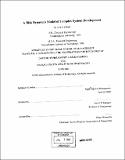
| dc.title | A risk dynamics model of complex system development | en_US |
| dc.type | Thesis | en_US |
| dc.description.degree | Ph.D. | en_US |
| dc.contributor.department | Sloan School of Management | |
| dc.identifier.oclc | 50758974 | en_US |