The MIT Libraries is completing a major upgrade to DSpace@MIT.
Starting May 5 2026, DSpace will remain functional, viewable, searchable, and downloadable, however, you will not be able to edit existing collections or add new material.
We are aiming to have full functionality restored by May 18, 2026, but intermittent service interruptions may occur.
Please email dspace-lib@mit.edu with any questions.
Thank you for your patience as we implement this important upgrade.
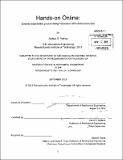
Hands-on online : towards experiential product design education with online resources
| dc.contributor.advisor | David R. Wallace. | en_US |
| dc.contributor.author | Ramos, Joshua D | en_US |
| dc.contributor.other | Massachusetts Institute of Technology. Department of Mechanical Engineering. | en_US |
| dc.date.accessioned | 2014-03-06T15:44:38Z | |
| dc.date.available | 2014-03-06T15:44:38Z | |
| dc.date.copyright | 2013 | en_US |
| dc.date.issued | 2013 | en_US |
| dc.identifier.uri | http://hdl.handle.net/1721.1/85474 | |
| dc.description | Thesis: S.M., Massachusetts Institute of Technology, Department of Mechanical Engineering, 2013. | en_US |
| dc.description | Cataloged from PDF version of thesis. | en_US |
| dc.description | Includes bibliographical references (pages 60-63). | en_US |
| dc.description.abstract | This pilot study investigates the potential for teaching experiential, hands-on product design online. Specifically, the work is a first attempt to elucidate differences in outcomes between residential, hands-on educational experiences and online, hands-on instruction. Product design education is a subject that presents many challenges in translation to an online setting. Abstract concepts like open-ended problem solving and physical concepts like prototyping are more difficult to teach online than more codified information. Three experimental groups were investigated. A traditional delivery group acted as a control for the study. Participants in the traditional group met at the Product Design Lab at MIT and learned the material through face-to-face lectures and demonstrations. The online group learned the material through an online resource developed specifically for this experiment. A third group, labeled the hybrid group, resembled a flipped classroom where participants learned the material on their own and then came to campus to practice what they learned. All groups took part in an opportunity identification activity in which participants identified problem solving opportunities, brainstormed solutions and developed prototypes to illustrate their most promising solution. Participants in this study attended a 2-day workshop covering the topics of design process, sketching and prototyping with simple materials. The designs developed by participants were collected and reviewed by a panel of product design experts, who then rated the work on the realness of the identified opportunity and the effectiveness of the prototype in illustrating the solution. The assessments were compared and statistical hypothesis testing was performed. All methods employed failed to reject the null hypothesis that the groups performed equally, providing evidence that learning gains were the same for all three delivery methods. Surveys taken by the participants revealed highest instructor ratings and overall learning ratings in traditional learning and the lowest ratings of resource adequacy in online learning. While this is an initial study with a relatively small sample size, the outcomes for early-stage product design instruction present interesting implications for both online and residential education in terms of improving education, and suggest a number of avenues for further study. | en_US |
| dc.description.statementofresponsibility | by Joshua D. Ramos. | en_US |
| dc.format.extent | 86 pages | en_US |
| dc.language.iso | eng | en_US |
| dc.publisher | Massachusetts Institute of Technology | en_US |
| dc.rights | M.I.T. theses are protected by copyright. They may be viewed from this source for any purpose, but reproduction or distribution in any format is prohibited without written permission. See provided URL for inquiries about permission. | en_US |
| dc.rights.uri | http://dspace.mit.edu/handle/1721.1/7582 | en_US |
| dc.subject | Mechanical Engineering. | en_US |
| dc.title | Hands-on online : towards experiential product design education with online resources | en_US |
| dc.type | Thesis | en_US |
| dc.description.degree | S.M. | en_US |
| dc.contributor.department | Massachusetts Institute of Technology. Department of Mechanical Engineering | |
| dc.identifier.oclc | 870970952 | en_US |