The MIT Libraries is completing a major upgrade to DSpace@MIT.
Starting May 5 2026, DSpace will remain functional, viewable, searchable, and downloadable, however, you will not be able to edit existing collections or add new material.
We are aiming to have full functionality restored by May 18, 2026, but intermittent service interruptions may occur.
Please email dspace-lib@mit.edu with any questions.
Thank you for your patience as we implement this important upgrade.
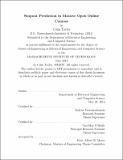
Stopout prediction in massive open online courses
| dc.contributor.advisor | Kalyan Veeramachaneni and Una-May O'Reilly. | en_US |
| dc.contributor.author | Taylor, Colin, S.M. (Colin J.). Massachusetts Institute of Technology | en_US |
| dc.contributor.other | Massachusetts Institute of Technology. Department of Electrical Engineering and Computer Science. | en_US |
| dc.date.accessioned | 2014-11-24T16:16:26Z | |
| dc.date.available | 2014-11-24T16:16:26Z | |
| dc.date.copyright | 2014 | en_US |
| dc.date.issued | 2014 | en_US |
| dc.identifier.uri | http://hdl.handle.net/1721.1/91699 | |
| dc.description | Thesis: M. Eng., Massachusetts Institute of Technology, Department of Electrical Engineering and Computer Science, 2014. | en_US |
| dc.description | This electronic version was submitted by the student author. The certified thesis is available in the Institute Archives and Special Collections. | en_US |
| dc.description | Cataloged from student-submitted PDF version of thesis. | en_US |
| dc.description | Includes bibliographical references (page 121). | en_US |
| dc.description.abstract | Imagine your favorite college professor standing behind a podium in the center of Michigan Stadium in Ann Arbor, lecturing 109,000 students. Though that sounds like an unlikely scenario, Massive Open Online Courses, MOOCs, have practically made that a reality by offering previously exclusive classes to mass audiences. However, as the barriers to entry for MOOCs are very low, student dropout, referred to as student `stopout' [2], is very high. We believe that studying why students stopout will enable us to more fully understand how students learn in MOOCs. This thesis applies a variety of machine learning algorithms to predict student persistence in MOOCs. We built predictive models by utilizing a framework that went through the following steps: organizing and curating the data, extracting predictive, sophisticated features, and developing a distributed, parallelizable framework. We built models capable of predicting stopout with AUCs¹ of up to 0.95. These models even give an indication of whether students stopout because of predisposed motivations or due to course content. Additionally, we uncovered a number of findings about the factors indicative of stopout. These factors are presented in Chapter 10. Through the prediction framework we hope to help educators understand the factors of persistence in MOOCs and provide insight that prevents stopout. To our knowledge, this is the first in-depth, accurate prediction of stopout in Massive Open Online Courses. | en_US |
| dc.description.statementofresponsibility | by Colin Taylor. | en_US |
| dc.format.extent | 121 pages | en_US |
| dc.language.iso | eng | en_US |
| dc.publisher | Massachusetts Institute of Technology | en_US |
| dc.rights | M.I.T. theses are protected by copyright. They may be viewed from this source for any purpose, but reproduction or distribution in any format is prohibited without written permission. See provided URL for inquiries about permission. | en_US |
| dc.rights.uri | http://dspace.mit.edu/handle/1721.1/7582 | en_US |
| dc.subject | Electrical Engineering and Computer Science. | en_US |
| dc.title | Stopout prediction in massive open online courses | en_US |
| dc.type | Thesis | en_US |
| dc.description.degree | M. Eng. | en_US |
| dc.contributor.department | Massachusetts Institute of Technology. Department of Electrical Engineering and Computer Science | |
| dc.identifier.oclc | 894358714 | en_US |