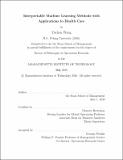
| dc.contributor.advisor | Dimitris Bertsimas. | en_US |
| dc.contributor.author | Wang, Yuchen. | en_US |
| dc.contributor.other | Massachusetts Institute of Technology. Operations Research Center. | en_US |
| dc.date.accessioned | 2020-09-15T21:50:42Z | |
| dc.date.available | 2020-09-15T21:50:42Z | |
| dc.date.copyright | 2020 | en_US |
| dc.date.issued | 2020 | en_US |
| dc.identifier.uri | https://hdl.handle.net/1721.1/127295 | |
| dc.description | Thesis: Ph. D., Massachusetts Institute of Technology, Sloan School of Management, Operations Research Center, May, 2020 | en_US |
| dc.description | Cataloged from the official PDF of thesis. | en_US |
| dc.description | Includes bibliographical references (pages 131-142). | en_US |
| dc.description.abstract | With data becoming increasingly available in recent years, black-box algorithms like boosting methods or neural networks play more important roles in the real world. However, interpretability is a severe need for several areas of applications, like health care or business. Doctors or managers often need to understand how models make predictions, in order to make their final decisions. In this thesis, we improve and propose some interpretable machine learning methods by using modern optimization. We also use two examples to illustrate how interpretable machine learning methods help to solve problems in health care. The first part of this thesis is about interpretable machine learning methods using modern optimization. In Chapter 2, we illustrate how to use robust optimization to improve the performance of SVM, Logistic Regression, and Classification Trees for imbalanced datasets. In Chapter 3, we discuss how to find optimal clusters for prediction. we use real-world datasets to illustrate this is a fast and scalable method with high accuracy. In Chapter 4, we deal with optimal regression trees with polynomial function in leaf nodes and demonstrate this method improves the out-of-sample performance. The second part of this thesis is about how interpretable machine learning methods improve the current health care system. In Chapter 5, we illustrate how we use Optimal Trees to predict the risk mortality for candidates awaiting liver transplantation. Then we develop a transplantation policy called Optimized Prediction of Mortality (OPOM), which reduces mortality significantly in simulation analysis and also improves fairness. In Chapter 6, we propose a new method based on Optimal Trees which perform better than original rules in identifying children at very low risk of clinically important traumatic brain injury (ciTBI). If this method is implemented in the electronic health record, the new rules may reduce unnecessary computed tomographies (CT). | en_US |
| dc.description.statementofresponsibility | by Yuchen Wang. | en_US |
| dc.format.extent | 142 pages | en_US |
| dc.language.iso | eng | en_US |
| dc.publisher | Massachusetts Institute of Technology | en_US |
| dc.rights | MIT theses may be protected by copyright. Please reuse MIT thesis content according to the MIT Libraries Permissions Policy, which is available through the URL provided. | en_US |
| dc.rights.uri | http://dspace.mit.edu/handle/1721.1/7582 | en_US |
| dc.subject | Operations Research Center. | en_US |
| dc.title | Interpretable machine learning methods with applications to health care | en_US |
| dc.type | Thesis | en_US |
| dc.description.degree | Ph. D. | en_US |
| dc.contributor.department | Massachusetts Institute of Technology. Operations Research Center | en_US |
| dc.contributor.department | Sloan School of Management | |
| dc.identifier.oclc | 1191901101 | en_US |
| dc.description.collection | Ph.D. Massachusetts Institute of Technology, Sloan School of Management, Operations Research Center | en_US |
| dspace.imported | 2020-09-15T21:50:42Z | en_US |
| mit.thesis.degree | Doctoral | en_US |
| mit.thesis.department | Sloan | en_US |
| mit.thesis.department | OperRes | en_US |