

Demonstrating NeuroFlux: A Non-Invasive Peripheral Magnetic Stimulation Device for Multimodal Haptic Feedback
Download3746058.3758984.pdf (2.215Mb)
Publisher Policy
Publisher Policy
Article is made available in accordance with the publisher's policy and may be subject to US copyright law. Please refer to the publisher's site for terms of use.
Terms of use
Metadata
Show full item recordAbstract
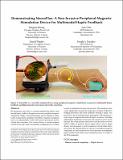
We demonstrate NeuroFlux, a wearable armband that delivers multimodal haptic feedback through non-invasive peripheral magnetic stimulation. Unlike conventional haptic devices limited to either tactile or kinesthetic modalities, NeuroFlux stimulates peripheral nerves to independently evoke both muscle movements and localized skin sensations. Our system features a custom-designed control circuit and a multi-coil armband, enabling precise, real-time control of stimulation location and intensity. This hardware innovation significantly expands the design space of haptic feedback by bridging kinesthetic and tactile modalities through a single, compact device. In our demonstration, participants will experience a wide range of magnetically induced haptic sensations, including independent stimulation of muscular and cutaneous nerves in the forearm. The setup includes interactive tasks that showcase NeuroFlux’s ability to generate diverse haptic effects such as finger flexion, wrist movement, as well as immersive virtual reality object interactions. By offering hands-on exposure to peripheral magnetic stimulation, we aim to spark new research directions in multimodal haptic feedback and make neural stimulation more accessible to the HCI community.
Description
UIST Adjunct ’25, Busan, Republic of Korea
Date issued
2025-09-27Department
Massachusetts Institute of Technology. Media LaboratoryPublisher
ACM|The 38th Annual ACM Symposium on User Interface Software and Technology
Citation
Bingjian Huang, Sam Chin, Daniel Wigdor, and Joseph A. Paradiso. 2025. Demonstrating NeuroFlux: A Non-Invasive Peripheral Magnetic Stimulation Device for Multimodal Haptic Feedback. In Adjunct Proceedings of the 38th Annual ACM Symposium on User Interface Software and Technology (UIST Adjunct '25). Association for Computing Machinery, New York, NY, USA, Article 23, 1–5.
Version: Final published version
ISBN
979-8-4007-2036-9