| dc.contributor.author | Du, Song-Pei | |
| dc.contributor.author | Didyk, Piotr | |
| dc.contributor.author | Durand, Fredo | |
| dc.contributor.author | Hu, Shi-Min | |
| dc.contributor.author | Matusik, Wojciech | |
| dc.date.accessioned | 2015-11-24T12:56:55Z | |
| dc.date.available | 2015-11-24T12:56:55Z | |
| dc.date.issued | 2014-11 | |
| dc.identifier.issn | 07300301 | |
| dc.identifier.uri | http://hdl.handle.net/1721.1/100012 | |
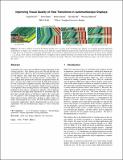
| dc.description.abstract | Automultiscopic screens present different images depending on the viewing direction. This enables glasses-free 3D and provides motion parallax effect. However, due to the limited angular resolution of such displays, they suffer from hot-spotting, i. e., image quality is highly affected by the viewing position. In this paper, we analyze light fields produced by lenticular and parallax-barrier displays, and show that, unlike in real world, the light fields produced by such screens have a repetitive structure. This induces visual artifacts in the form of view discontinuities, depth reversals, and excessive disparities when viewing position is not optimal. Although the problem has been always considered as inherent to the technology, we demonstrate that light fields reproduced on automultiscopic displays have enough degrees of freedom to improve the visual quality. We propose a new technique that modifies light fields using global and local shears followed by stitching to improve their continuity when displayed on a screen. We show that this enhances visual quality significantly, which is demonstrated in a series of user experiments with an automultiscopic display as well as lenticular prints. | en_US |
| dc.description.sponsorship | National Science Foundation (U.S.) (IIS-1111415) | en_US |
| dc.description.sponsorship | National Science Foundation (U.S.) (IIS-1116296) | en_US |
| dc.description.sponsorship | Quanta Computer (Firm) | en_US |
| dc.description.sponsorship | National Basic Research Program of China (973 Program) (Project 2011CB302205) | en_US |
| dc.description.sponsorship | National Natural Science Foundation (China) (Project 61272226/61120106007) | en_US |
| dc.description.sponsorship | National High-Tech R&D (863) Plan of China (Project 2013AA013903) | en_US |
| dc.description.sponsorship | Beijing Higher Institution Engineering Research Center (Research Grant) | en_US |
| dc.language.iso | en_US | |
| dc.publisher | Association for Computing Machinery (ACM) | en_US |
| dc.relation.isversionof | http://dx.doi.org/10.1145/2661229.2661248 | en_US |
| dc.rights | Creative Commons Attribution-Noncommercial-Share Alike | en_US |
| dc.rights.uri | http://creativecommons.org/licenses/by-nc-sa/4.0/ | en_US |
| dc.source | MIT web domain | en_US |
| dc.title | Improving visual quality of view transitions in automultiscopic displays | en_US |
| dc.type | Article | en_US |
| dc.identifier.citation | Du, Song-Pei, Piotr Didyk, Fredo Durand, Shi-Min Hu, and Wojciech Matusik. “Improving Visual Quality of View Transitions in Automultiscopic Displays.” ACM Transactions on Graphics 33, no. 6 (November 19, 2014): 1–9. | en_US |
| dc.contributor.department | Massachusetts Institute of Technology. Computer Science and Artificial Intelligence Laboratory | en_US |
| dc.contributor.department | Massachusetts Institute of Technology. Department of Electrical Engineering and Computer Science | en_US |
| dc.contributor.mitauthor | Du, Song-Pei | en_US |
| dc.contributor.mitauthor | Didyk, Piotr | en_US |
| dc.contributor.mitauthor | Durand, Fredo | en_US |
| dc.contributor.mitauthor | Matusik, Wojciech | en_US |
| dc.relation.journal | ACM Transactions on Graphics | en_US |
| dc.eprint.version | Author's final manuscript | en_US |
| dc.type.uri | http://purl.org/eprint/type/ConferencePaper | en_US |
| eprint.status | http://purl.org/eprint/status/NonPeerReviewed | en_US |
| dspace.orderedauthors | Du, Song-Pei; Didyk, Piotr; Durand, Fredo; Hu, Shi-Min; Matusik, Wojciech | en_US |
| dc.identifier.orcid | https://orcid.org/0000-0003-0212-5643 | |
| dc.identifier.orcid | https://orcid.org/0000-0001-9919-069X | |
| mit.license | OPEN_ACCESS_POLICY | en_US |
| mit.metadata.status | Complete | |