| dc.contributor.author | Chang, Wendi | |
| dc.contributor.author | Akselrod, Gleb Markovitch | |
| dc.contributor.author | Bulovic, Vladimir | |
| dc.date.accessioned | 2016-05-03T00:09:12Z | |
| dc.date.available | 2016-05-03T00:09:12Z | |
| dc.date.issued | 2015-04 | |
| dc.date.submitted | 2015-02 | |
| dc.identifier.issn | 1936-0851 | |
| dc.identifier.issn | 1936-086X | |
| dc.identifier.uri | http://hdl.handle.net/1721.1/102364 | |
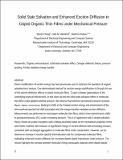
| dc.description.abstract | Direct modification of exciton energy has been previously used to optimize the operation of organic optoelectronic devices. One demonstrated method for exciton energy modification is through the use of the solvent dielectric effects in doped molecular films. To gain a deeper appreciation of the underlying physical mechanisms, in this work we test the solid-state solvation effect in molecular thin films under applied external pressure. We observe that external mechanical pressure increases dipole–dipole interactions, leading to shifts in the Frenkel exciton energy and enhancement of the time-resolved spectral red shift associated with the energy-transfer-mediated exciton diffusion. Measurements are performed on host:dopant molecular thin films, which show bathochromic shifts in photoluminescence (PL) under increasing pressure. This is in agreement with a simple solvation theory model of exciton energetics with a fitting parameter based on the mechanical properties of the host matrix material. We measure no significant change in exciton lifetime with increasing pressure, consistent with unchanged aggregation in molecular films under compression. However, we do observe an increase in exciton spectral thermalization rate for compressed molecular films, indicating enhanced exciton diffusion for increased dipole–dipole interactions under pressure. The results highlight the contrast between molecular energy landscapes obtained when dipole–dipole interactions are increased by the pressure technique versus the conventional dopant concentration variation methods, which can lead to extraneous effects such as aggregation at higher doping concentrations. The present work demonstrates the use of pressure-probing techniques in studying energy disorder and exciton dynamics in amorphous molecular thin films. | en_US |
| dc.description.sponsorship | National Science Foundation (U.S.) | en_US |
| dc.description.sponsorship | United States. Dept. of Energy. Center for Excitonics (Award DE-SC0001088) | en_US |
| dc.language.iso | en_US | |
| dc.publisher | American Chemical Society (ACS) | en_US |
| dc.relation.isversionof | http://dx.doi.org/10.1021/acsnano.5b00938 | en_US |
| dc.rights | Article is made available in accordance with the publisher's policy and may be subject to US copyright law. Please refer to the publisher's site for terms of use. | en_US |
| dc.source | Chang | en_US |
| dc.title | Solid-State Solvation and Enhanced Exciton Diffusion in Doped Organic Thin Films under Mechanical Pressure | en_US |
| dc.type | Article | en_US |
| dc.identifier.citation | Chang, Wendi, Gleb M. Akselrod, and Vladimir Bulovic. “Solid-State Solvation and Enhanced Exciton Diffusion in Doped Organic Thin Films Under Mechanical Pressure.” ACS Nano 9, no. 4 (April 28, 2015): 4412–4418. | en_US |
| dc.contributor.department | Massachusetts Institute of Technology. Department of Electrical Engineering and Computer Science | en_US |
| dc.contributor.department | Massachusetts Institute of Technology. School of Engineering | en_US |
| dc.contributor.approver | Chang, Wendi | en_US |
| dc.contributor.mitauthor | Chang, Wendi | en_US |
| dc.contributor.mitauthor | Bulovic, Vladimir | en_US |
| dc.relation.journal | ACS Nano | en_US |
| dc.eprint.version | Author's final manuscript | en_US |
| dc.type.uri | http://purl.org/eprint/type/JournalArticle | en_US |
| eprint.status | http://purl.org/eprint/status/PeerReviewed | en_US |
| dspace.orderedauthors | Chang, Wendi; Akselrod, Gleb M.; Bulovic, Vladimir | en_US |
| dc.identifier.orcid | https://orcid.org/0000-0002-0960-2580 | |
| mit.license | PUBLISHER_POLICY | en_US |
| mit.metadata.status | Complete | |