| dc.contributor.author | Mulgaonkar, Yash | |
| dc.contributor.author | Araki, Brandon | |
| dc.contributor.author | Koh, Je-sung | |
| dc.contributor.author | Guerrero-Bonilla, Luis | |
| dc.contributor.author | Aukes, Daniel M. | |
| dc.contributor.author | Makineni, Anurag | |
| dc.contributor.author | Tolley, Michael T. | |
| dc.contributor.author | Rus, Daniela L. | |
| dc.contributor.author | Wood, Robert J. | |
| dc.contributor.author | Kumar, Vijay | |
| dc.date.accessioned | 2016-06-09T13:13:29Z | |
| dc.date.available | 2016-06-09T13:13:29Z | |
| dc.date.issued | 2016-05 | |
| dc.identifier.uri | http://hdl.handle.net/1721.1/103070 | |
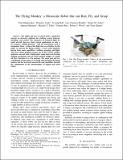
| dc.description.abstract | The agility and ease of control make a quadrotor aircraft an attractive platform for studying swarm behavior, modeling, and control. The energetics of sustained flight for small aircraft, however, limit typical applications to only a few minutes. Adding payloads – and the mechanisms used to manipulate them – reduces this flight time even further. In this paper we present the flying monkey, a novel robot platform having three main capabilities: walking, grasping, and flight. This new robotic platform merges one of the world’s smallest quadrotor aircraft with a lightweight, single-degree-of-freedom walking mechanism and an SMA-actuated gripper to enable all three functions in a 30 g package. The main goal and key contribution of this paper is to design and prototype the flying monkey that has increased mission life and capabilities through the combination of the functionalities of legged and aerial roots. | en_US |
| dc.description.sponsorship | National Science Foundation (U.S.) (IIS-1138847) | en_US |
| dc.description.sponsorship | National Science Foundation (U.S.) (EFRI-124038) | en_US |
| dc.description.sponsorship | National Science Foundation (U.S.) (CCF-1138967) | en_US |
| dc.description.sponsorship | United States. Army Research Laboratory (W911NF-08-2-0004) | en_US |
| dc.description.sponsorship | Wyss Institute for Biologically Inspired Engineering | en_US |
| dc.language.iso | en_US | |
| dc.publisher | Institute of Electrical and Electronics Engineers (IEEE) | en_US |
| dc.relation.isversionof | https://ras.papercept.net/conferences/conferences/ICRA16/program/ICRA16_ContentListWeb_4.html#thbat3_02 | en_US |
| dc.rights | Creative Commons Attribution-Noncommercial-Share Alike | en_US |
| dc.rights.uri | http://creativecommons.org/licenses/by-nc-sa/4.0/ | en_US |
| dc.source | Araki | en_US |
| dc.title | The Flying Monkey: a Mesoscale Robot that can Run, Fly, and Grasp | en_US |
| dc.type | Article | en_US |
| dc.identifier.citation | Mulgaonkar, Yash, Brandon Araki, Je-sung Koh, Luis Guerrero-Bonilla, Daniel M. Aukes, Anurag Makineni, Michael T. Tolley, Daniela L. Rus, Robert J. Wood, and Vijay Kumar. "The Flying Monkey: a Mesoscale Robot that can Run, Fly, and Grasp." 2016 IEEE International Conference on Robotics and Automation (May 2016). | en_US |
| dc.contributor.department | Massachusetts Institute of Technology. Computer Science and Artificial Intelligence Laboratory | en_US |
| dc.contributor.approver | Rus, Daniela L. | en_US |
| dc.contributor.mitauthor | Araki, Brandon | en_US |
| dc.contributor.mitauthor | Rus, Daniela L. | en_US |
| dc.relation.journal | Proceedings of the 2016 IEEE International Conference on Robotics and Automation | en_US |
| dc.eprint.version | Author's final manuscript | en_US |
| dc.type.uri | http://purl.org/eprint/type/ConferencePaper | en_US |
| eprint.status | http://purl.org/eprint/status/NonPeerReviewed | en_US |
| dspace.orderedauthors | Mulgaonkar, Yash; Araki, Brandon; Koh, Je-sung; Guerrero-Bonilla, Luis; Aukes, Daniel M.; Makineni, Anurag; Tolley, Michael T.; Rus, Daniela L.; Wood, Robert J. ; Kumar, Vijay | en_US |
| dspace.embargo.terms | N | en_US |
| dc.identifier.orcid | https://orcid.org/0000-0002-3094-1587 | |
| dc.identifier.orcid | https://orcid.org/0000-0001-5473-3566 | |
| mit.license | OPEN_ACCESS_POLICY | en_US |