| dc.contributor.author | Meixell, Brandt W. | |
| dc.contributor.author | Arnold, Todd W. | |
| dc.contributor.author | Lindberg, Mark S. | |
| dc.contributor.author | Smith, Matthew M. | |
| dc.contributor.author | Ramey, Andrew M. | |
| dc.contributor.author | Runstadler, Jonathan | |
| dc.date.accessioned | 2016-08-26T20:04:19Z | |
| dc.date.available | 2016-08-26T20:04:19Z | |
| dc.date.issued | 2016-07 | |
| dc.date.submitted | 2016-03 | |
| dc.identifier.issn | 1756-3305 | |
| dc.identifier.uri | http://hdl.handle.net/1721.1/104050 | |
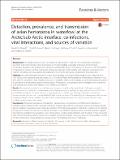
| dc.description.abstract | Background
The epidemiology of avian hematozoa at high latitudes is still not well understood, particularly in sub-Arctic and Arctic habitats, where information is limited regarding seasonality and range of transmission, co-infection dynamics with parasitic and viral agents, and possible fitness consequences of infection. Such information is important as climate warming may lead to northward expansion of hematozoa with unknown consequences to northern-breeding avian taxa, particularly populations that may be previously unexposed to blood parasites.
Methods
We used molecular methods to screen blood samples and cloacal/oropharyngeal swabs collected from 1347 ducks of five species during May-August 2010, in interior Alaska, for the presence of hematozoa, Influenza A Virus (IAV), and IAV antibodies. Using models to account for imperfect detection of parasites, we estimated seasonal variation in prevalence of three parasite genera (Haemoproteus, Plasmodium, Leucocytozoon) and investigated how co-infection with parasites and viruses were related to the probability of infection.
Results
We detected parasites from each hematozoan genus in adult and juvenile ducks of all species sampled. Seasonal patterns in detection and prevalence varied by parasite genus and species, age, and sex of duck hosts. The probabilities of infection for Haemoproteus and Leucocytozoon parasites were strongly positively correlated, but hematozoa infection was not correlated with IAV infection or serostatus. The probability of Haemoproteus infection was negatively related to body condition in juvenile ducks; relationships between Leucocytozoon infection and body condition varied among host species.
Conclusions
We present prevalence estimates for Haemoproteus, Leucocytozoon, and Plasmodium infections in waterfowl at the interface of the sub-Arctic and Arctic and provide evidence for local transmission of all three parasite genera. Variation in prevalence and molecular detection of hematozoa parasites in wild ducks is influenced by seasonal timing and a number of host traits. A positive correlation in co-infection of Leucocytozoon and Haemoproteus suggests that infection probability by parasites in one or both genera is enhanced by infection with the other, or that encounter rates of hosts and genus-specific vectors are correlated. Using size-adjusted mass as an index of host condition, we did not find evidence for strong deleterious consequences of hematozoa infection in wild ducks. | en_US |
| dc.description.sponsorship | Geological Survey (U.S.) (Wildlife Program of the Ecosystem Mission Area) | en_US |
| dc.description.sponsorship | U.S. Fish and Wildlife Service | en_US |
| dc.description.sponsorship | Delta Waterfowl Foundation | en_US |
| dc.description.sponsorship | Institute for Wetland and Waterfowl Research | en_US |
| dc.description.sponsorship | Icahn School of Medicine at Mount Sinai (Center for Research on Influenza Pathogenesis) | en_US |
| dc.description.sponsorship | Center of Excellence for Influenza Research and Surveillance (contracts HHSN272201400008C and HHSN266200700010C) | en_US |
| dc.publisher | BioMed Central | en_US |
| dc.relation.isversionof | http://dx.doi.org/10.1186/s13071-016-1666-3 | en_US |
| dc.rights | Creative Commons Attribution | en_US |
| dc.rights.uri | http://creativecommons.org/licenses/by/4.0/ | en_US |
| dc.source | BioMed Central | en_US |
| dc.title | Detection, prevalence, and transmission of avian hematozoa in waterfowl at the Arctic/sub-Arctic interface: co-infections, viral interactions, and sources of variation | en_US |
| dc.type | Article | en_US |
| dc.identifier.citation | Meixell, Brandt W. et al. “Detection, Prevalence, and Transmission of Avian Hematozoa in Waterfowl at the Arctic/sub-Arctic Interface: Co-Infections, Viral Interactions, and Sources of Variation.” Parasites & Vectors 9.1 (2016): n. pag. | en_US |
| dc.contributor.department | Massachusetts Institute of Technology. Department of Biological Engineering | en_US |
| dc.contributor.department | Massachusetts Institute of Technology. Division of Comparative Medicine | en_US |
| dc.contributor.mitauthor | Runstadler, Jonathan | en_US |
| dc.relation.journal | Parasites & Vectors | en_US |
| dc.eprint.version | Final published version | en_US |
| dc.type.uri | http://purl.org/eprint/type/JournalArticle | en_US |
| eprint.status | http://purl.org/eprint/status/PeerReviewed | en_US |
| dc.date.updated | 2016-08-03T08:16:05Z | |
| dc.language.rfc3066 | en | |
| dc.rights.holder | The Author(s). | |
| dspace.orderedauthors | Meixell, Brandt W.; Arnold, Todd W.; Lindberg, Mark S.; Smith, Matthew M.; Runstadler, Jonathan A.; Ramey, Andrew M. | en_US |
| dspace.embargo.terms | N | en_US |
| dc.identifier.orcid | https://orcid.org/0000-0002-6747-7765 | |
| mit.license | PUBLISHER_CC | en_US |