| dc.contributor.author | Lathrop-Marshall, Hillary | |
| dc.contributor.author | Chen, Justin | |
| dc.contributor.author | Rothman, Alyssa L. | |
| dc.contributor.author | Jacox, Laura A. | |
| dc.contributor.author | Sive, Hazel L. | |
| dc.date.accessioned | 2017-02-03T21:33:13Z | |
| dc.date.available | 2017-02-03T21:33:13Z | |
| dc.date.issued | 2016-07 | |
| dc.date.submitted | 2016-05 | |
| dc.identifier.issn | 2211-1247 | |
| dc.identifier.uri | http://hdl.handle.net/1721.1/106859 | |
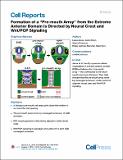
| dc.description.abstract | The mouth arises from the extreme anterior domain (EAD), a region where the ectoderm and endoderm are directly juxtaposed. Here, we identify a ‘‘premouth array’’ in Xenopus that forms soon after the cranial neural crest has migrated to lie on either side of the EAD. Initially, EAD ectoderm comprises a wide and short epithelial mass that becomes narrow and tall with cells and nuclei changing shape, a characteristic of convergent extension. The resulting two rows of cells—the pre-mouth array—later split
down the midline to surround the mouth opening. Neural crest is essential for convergent extension and likely signals to the EAD through the Wnt/planar
cell polarity (PCP) pathway. Fzl7 receptor is locally required in EAD ectoderm, while Wnt11 ligand is required more globally. Indeed, heterologous cells expressing Wnt11 can elicit EAD convergent extension. The study reveals a precise cellular mechanism that positions and contributes to the future mouth. | en_US |
| dc.description.sponsorship | National Institute of Dental and Craniofacial Research (U.S.) (Grants 1R01 DE021109-01 and F30DE022989) | en_US |
| dc.description.sponsorship | Harvard University (Herschel Smith Graduate Fellowship) | en_US |
| dc.language.iso | en_US | |
| dc.publisher | Elsevier | en_US |
| dc.relation.isversionof | http://dx.doi.org/10.1016/j.celrep.2016.06.073 | en_US |
| dc.rights | Creative Commons Attribution-NonCommercial-NoDerivs License | en_US |
| dc.rights.uri | http://creativecommons.org/licenses/by-nc-nd/4.0/ | en_US |
| dc.source | Elsevier | en_US |
| dc.title | Formation of a “Pre-mouth Array” from the Extreme Anterior Domain Is Directed by Neural Crest and Wnt/PCP Signaling | en_US |
| dc.type | Article | en_US |
| dc.identifier.citation | Jacox, Laura et al. “Formation of a ‘Pre-Mouth Array’ from the Extreme Anterior Domain Is Directed by Neural Crest and Wnt/PCP Signaling.” Cell Reports 16.5 (2016): 1445–1455. | en_US |
| dc.contributor.department | Harvard University--MIT Division of Health Sciences and Technology | en_US |
| dc.contributor.department | Massachusetts Institute of Technology. Department of Biology | en_US |
| dc.contributor.department | Whitehead Institute for Biomedical Research | en_US |
| dc.contributor.mitauthor | Jacox, Laura A | |
| dc.contributor.mitauthor | Chen, Justin | |
| dc.contributor.mitauthor | Rothman, Alyssa L. | |
| dc.contributor.mitauthor | Sive, Hazel L | |
| dc.relation.journal | Cell Reports | en_US |
| dc.eprint.version | Final published version | en_US |
| dc.type.uri | http://purl.org/eprint/type/JournalArticle | en_US |
| eprint.status | http://purl.org/eprint/status/PeerReviewed | en_US |
| dspace.orderedauthors | Jacox, Laura; Chen, Justin; Rothman, Alyssa; Lathrop-Marshall, Hillary; Sive, Hazel | en_US |
| dspace.embargo.terms | N | en_US |
| dc.identifier.orcid | https://orcid.org/0000-0001-6631-0042 | |
| dc.identifier.orcid | https://orcid.org/0000-0002-2634-6689 | |
| dc.identifier.orcid | https://orcid.org/0000-0002-4890-424X | |
| mit.license | PUBLISHER_CC | en_US |
| mit.metadata.status | Complete | |