| dc.contributor.author | Duro-Royo, Jorge | |
| dc.contributor.author | Zolotovsky, Katia | |
| dc.contributor.author | Mogas-Soldevila, Laia | |
| dc.contributor.author | Varshney, Swati Rani | |
| dc.contributor.author | Oxman, Neri | |
| dc.contributor.author | Boyce, Mary Cunningham | |
| dc.contributor.author | Ortiz, Christine | |
| dc.date.accessioned | 2017-03-02T21:01:10Z | |
| dc.date.available | 2017-03-02T21:01:10Z | |
| dc.date.issued | 2014-05 | |
| dc.identifier.issn | 00104485 | |
| dc.identifier.uri | http://hdl.handle.net/1721.1/107166 | |
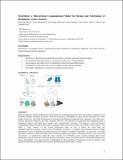
| dc.description.abstract | Many exoskeletons exhibit multifunctional performance by combining protection from rigid ceramic components with flexibility through articulated interfaces. Structure-to-function relationships of these natural bioarmors have been studied extensively, and initial development of structural (load-bearing) bioinspired armor materials, most often nacre-mimetic laminated composites, has been conducted. However, the translation of segmented and articulated armor to bioinspired surfaces and applications requires new computational constructs. We propose a novel hierarchical computational model, MetaMesh, that adapts a segmented fish scale armor system to fit complex “host surfaces”. We define a “host” surface as the overall geometrical form on top of which the scale units are computed. MetaMesh operates in three levels of resolution: (i) locally—to construct unit geometries based on shape parameters of scales as identified and characterized in the Polypterus senegalus exoskeleton, (ii) regionally—to encode articulated connection guides that adapt units with their neighbors according to directional schema in the mesh, and (iii) globally—to generatively extend the unit assembly over arbitrarily curved surfaces through global mesh optimization using a functional coefficient gradient. Simulation results provide the basis for further physiological and kinetic development. This study provides a methodology for the generation of biomimetic protective surfaces using segmented, articulated components that maintain mobility alongside full body coverage. | en_US |
| dc.description.sponsorship | Massachusetts Institute of Technology. Institute for Soldier Nanotechnologies (Contract No. W911NF-13-D-0001) | en_US |
| dc.description.sponsorship | United States. Army Research Office (Institute for Collaborative Biotechnologies (ICB), contract no. W911NF-09-D-0001) | en_US |
| dc.description.sponsorship | United States. Department of Defense (National Security Science and Engineering Faculty Fellowship Program (Grant No. N00244-09-1-0064)) | en_US |
| dc.language.iso | en_US | |
| dc.publisher | Elsevier B.V. | en_US |
| dc.relation.isversionof | http://dx.doi.org/10.1016/j.cad.2014.05.005 | en_US |
| dc.rights | Creative Commons Attribution-NonCommercial-NoDerivs License | en_US |
| dc.rights.uri | http://creativecommons.org/licenses/by-nc-nd/4.0/ | en_US |
| dc.source | Prof. Ortiz via Angie Locknar | en_US |
| dc.title | MetaMesh: A hierarchical computational model for design and fabrication of biomimetic armored surfaces | en_US |
| dc.type | Article | en_US |
| dc.identifier.citation | Duro-Royo, Jorge, Katia Zolotovsky, Laia Mogas-Soldevila, Swati Varshney, Neri Oxman, Mary C. Boyce, and Christine Ortiz. “MetaMesh: A Hierarchical Computational Model for Design and Fabrication of Biomimetic Armored Surfaces.” Computer-Aided Design 60 (March 2015): 14–27. | en_US |
| dc.contributor.department | Massachusetts Institute of Technology. Department of Architecture | en_US |
| dc.contributor.department | Massachusetts Institute of Technology. Department of Materials Science and Engineering | en_US |
| dc.contributor.department | Massachusetts Institute of Technology. Department of Mechanical Engineering | en_US |
| dc.contributor.department | Massachusetts Institute of Technology. Media Laboratory | en_US |
| dc.contributor.approver | Ortiz, Christine | en_US |
| dc.contributor.mitauthor | Duro-Royo, Jorge | |
| dc.contributor.mitauthor | Zolotovsky, Katia | |
| dc.contributor.mitauthor | Mogas-Soldevila, Laia | |
| dc.contributor.mitauthor | Varshney, Swati Rani | |
| dc.contributor.mitauthor | Oxman, Neri | |
| dc.contributor.mitauthor | Boyce, Mary Cunningham | |
| dc.contributor.mitauthor | Ortiz, Christine | |
| dc.relation.journal | Computer-Aided Design | en_US |
| dc.eprint.version | Author's final manuscript | en_US |
| dc.type.uri | http://purl.org/eprint/type/JournalArticle | en_US |
| eprint.status | http://purl.org/eprint/status/PeerReviewed | en_US |
| dspace.orderedauthors | Duro-Royo, Jorge; Zolotovsky, Katia; Mogas-Soldevila, Laia; Varshney, Swati; Oxman, Neri; Boyce, Mary C.; Ortiz, Christine | en_US |
| dspace.embargo.terms | N | en_US |
| dc.identifier.orcid | https://orcid.org/0000-0002-9249-6095 | |
| dc.identifier.orcid | https://orcid.org/0000-0002-8030-499X | |
| dc.identifier.orcid | https://orcid.org/0000-0001-6296-2617 | |
| dc.identifier.orcid | https://orcid.org/0000-0001-9222-4447 | |
| dc.identifier.orcid | https://orcid.org/0000-0002-2193-377X | |
| dc.identifier.orcid | https://orcid.org/0000-0003-3511-5679 | |
| mit.license | PUBLISHER_CC | en_US |