| dc.contributor.author | Wang, Jia | |
| dc.contributor.author | Chua, Lloyd H. C. | |
| dc.contributor.author | Shanahan, Peter | |
| dc.date.accessioned | 2017-05-02T18:38:22Z | |
| dc.date.available | 2017-05-02T18:38:22Z | |
| dc.date.issued | 2016-11 | |
| dc.date.submitted | 2016-10 | |
| dc.identifier.issn | 2053-1400 | |
| dc.identifier.issn | 2053-1419 | |
| dc.identifier.uri | http://hdl.handle.net/1721.1/108609 | |
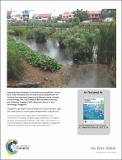
| dc.description.abstract | Non-point source pollution is a prevalent problem throughout the world. Bioretention basins have been deployed worldwide to treat stormwater runoff and alleviate eutrophication in downstream water resources. However, basin performance in the tropics is poorly understood. Given the distinctly different rainfall-runoff characteristics of tropical climates, whether basins that are built according to temperate design guidelines are effective is questionable. There have been no field studies based on continuous, high-resolution, long-term monitoring in the tropics. In this study, 96 storms were monitored in the first bioretention basin in Singapore. Of these, flow measurements were made during 80 events and samples were collected and analyzed for 15 water quality parameters (including nitrogen and phosphorus species, total suspended solids, and chemical oxygen demand) during six events. The mean removal rates were 25%, 46%, and 53% for total nitrogen, total phosphorus, and total suspended solids respectively. Results show that a lack of storage capacity and resulting high overflow reduce pollutant removal efficiency for high-rainfall-depth events. The transition from efficient to non-efficient removal occurs at a rainfall depth between 10 and 30 mm. Low EMC (event mean concentration) and weak first flush as a result of frequent and intense rainfall in the tropics also contribute to low removal rate. The results suggest a need to revise bioretention basin design guidelines for the tropics to be based on WQV or WQD (water quality volume or depth) instead of ARI (average recurrence interval). A larger basin volume (WQD between 10 to 30 mm) is recommended. | en_US |
| dc.description.sponsorship | Singapore. National Research Foundation (Singapore-MIT Alliance for Research and Technology. Center for Environmental Sensing and Modeling) | en_US |
| dc.language.iso | en_US | |
| dc.publisher | Royal Society of Chemistry | en_US |
| dc.relation.isversionof | http://dx.doi.org/10.1039/C6EW00285D | en_US |
| dc.rights | Creative Commons Attribution-NonCommercial 3.0 Unported | en_US |
| dc.rights.uri | https://creativecommons.org/licenses/by-nc/3.0/ | en_US |
| dc.source | Royal Society of Chemistry | en_US |
| dc.title | Evaluation of pollutant removal efficiency of a bioretention basin and implications for stormwater management in tropical cities | en_US |
| dc.type | Article | en_US |
| dc.identifier.citation | Wang, Jia, Lloyd H. C. Chua, and Peter Shanahan. “Evaluation of Pollutant Removal Efficiency of a Bioretention Basin and Implications for Stormwater Management in Tropical Cities.” Environmental Science: Water Research Technol. 3.1 (2017): 78–91. © 2017 The Royal Society of Chemistry | en_US |
| dc.contributor.department | Massachusetts Institute of Technology. Department of Civil and Environmental Engineering | en_US |
| dc.contributor.mitauthor | Wang, Jia | |
| dc.contributor.mitauthor | Shanahan, Peter | |
| dc.relation.journal | Environment Science: Water Research & Technology | en_US |
| dc.eprint.version | Final published version | en_US |
| dc.type.uri | http://purl.org/eprint/type/JournalArticle | en_US |
| eprint.status | http://purl.org/eprint/status/PeerReviewed | en_US |
| dspace.orderedauthors | Wang, Jia; Chua, Lloyd H. C.; Shanahan, Peter | en_US |
| dspace.embargo.terms | N | en_US |
| dc.identifier.orcid | https://orcid.org/0000-0001-8667-8186 | |
| mit.license | PUBLISHER_CC | en_US |
| mit.metadata.status | Complete | |