| dc.contributor.author | Koo, Byungjin | |
| dc.contributor.author | Sletten, Ellen M. | |
| dc.contributor.author | Swager, Timothy M | |
| dc.date.accessioned | 2017-07-03T13:13:55Z | |
| dc.date.available | 2017-07-03T13:13:55Z | |
| dc.date.issued | 2014-12 | |
| dc.date.submitted | 2014-09 | |
| dc.identifier.issn | 0024-9297 | |
| dc.identifier.issn | 1520-5835 | |
| dc.identifier.uri | http://hdl.handle.net/1721.1/110415 | |
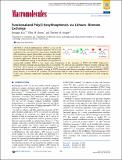
| dc.description.abstract | Poly(3-hexylthiophene) (P3HT) is one of the most extensively investigated conjugated polymers and has been employed as the active material in many devices including field-effect transistors, organic photovoltaics and sensors. As a result, methods to further tune the properties of P3HT are desirable for specific applications. Herein, we report a facile postpolymerization modification strategy to functionalize the 4-position of commercially available P3HT in two simple steps–bromination of the 4-position of P3HT (Br–P3HT) followed by lithium−bromine exchange and quenching with an electrophile. We achieved near quantitative lithium–bromine exchange with Br–P3HT, which requires over 100 thienyl lithiates to be present on a single polymer chain. The lithiated-P3HT is readily combined with functional electrophiles, resulting in P3HT derivatives with ketones, secondary alcohols, trimethylsilyl (TMS) group, fluorine, or an azide at the 4-position. We demonstrated that the azide-modified P3HT could undergo Cu-catalyzed or Cu-free click chemistry, significantly expanding the complexity of the structures that can be appended to P3HT using this method. | en_US |
| dc.description.sponsorship | National Science Foundation (U.S.) (ECCS-0939514) | en_US |
| dc.language.iso | en_US | |
| dc.publisher | American Chemical Society (ACS) | en_US |
| dc.relation.isversionof | http://dx.doi.org/10.1021/ma5019044 | en_US |
| dc.rights | Article is made available in accordance with the publisher's policy and may be subject to US copyright law. Please refer to the publisher's site for terms of use. | en_US |
| dc.source | ACS | en_US |
| dc.title | Functionalized Poly(3-hexylthiophene)s via Lithium–Bromine Exchange | en_US |
| dc.type | Article | en_US |
| dc.identifier.citation | Koo, Byungjin; Sletten, Ellen M. and Swager, Timothy M. "Functionalized Poly(3-hexylthiophene)s via Lithium–Bromine Exchange." Macromolecules 48, 1 (December 2014): 229–235 © 2014 American Chemical Society | en_US |
| dc.contributor.department | Massachusetts Institute of Technology. Department of Chemistry | en_US |
| dc.contributor.department | Massachusetts Institute of Technology. Department of Materials Science and Engineering | en_US |
| dc.contributor.mitauthor | Koo, Byungjin | |
| dc.contributor.mitauthor | Sletten, Ellen M. | |
| dc.contributor.mitauthor | Swager, Timothy M | |
| dc.relation.journal | Macromolecules | en_US |
| dc.eprint.version | Final published version | en_US |
| dc.type.uri | http://purl.org/eprint/type/JournalArticle | en_US |
| eprint.status | http://purl.org/eprint/status/PeerReviewed | en_US |
| dspace.orderedauthors | Koo, Byungjin; Sletten, Ellen M.; Swager, Timothy M. | en_US |
| dspace.embargo.terms | N | en_US |
| dc.identifier.orcid | https://orcid.org/0000-0003-0681-8084 | |
| mit.license | PUBLISHER_POLICY | en_US |
| mit.metadata.status | Complete | |