| dc.contributor.author | Mehta, Karan Kartik | |
| dc.contributor.author | Bruzewicz, Colin D. | |
| dc.contributor.author | McConnell, Robert P. | |
| dc.contributor.author | Ram, Rajeev J | |
| dc.contributor.author | Sage, Jeremy M. | |
| dc.contributor.author | Chiaverini, John | |
| dc.date.accessioned | 2017-09-22T14:45:38Z | |
| dc.date.available | 2017-09-22T14:45:38Z | |
| dc.date.issued | 2016-08 | |
| dc.date.submitted | 2016-01 | |
| dc.identifier.issn | 1748-3387 | |
| dc.identifier.issn | 1748-3395 | |
| dc.identifier.uri | http://hdl.handle.net/1721.1/111621 | |
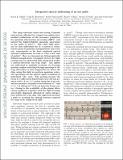
| dc.description.abstract | The long coherence times and strong Coulomb interactions afforded by trapped ion qubits have enabled realizations of the necessary primitives for quantum information processing and the highest-fidelity quantum operations in any qubit to date. Although light delivery to each individual ion in a system is essential for general quantum manipulations and readout, experiments so far have employed optical systems that are cumbersome to scale to even a few tens of qubits. Here we demonstrate lithographically defined nanophotonic waveguide devices for light routing and ion addressing that are fully integrated within a surface-electrode ion trap chip. Ion qubits are addressed at multiple locations via focusing grating couplers emitting through openings in the trap electrodes to ions trapped 50 μm above the chip; using this light, we perform quantum coherent operations on the optical qubit transition in individual ⁸⁸Sr⁺ ions. The grating focuses the beam to a diffraction-limited spot near the ion position with 2 μm 1/e² radius along the trap axis, and we measure crosstalk errors between 10⁻² and 4 × 10⁻² at distances 7.5–15 μm from the beam centre. Owing to the scalability of the planar fabrication technique employed, together with the tight focusing and stable alignment afforded by the integration of the optics within the trap chip, this approach presents a path to creating the optical systems required for large-scale trapped-ion quantum information processing. | en_US |
| dc.description.sponsorship | National Science Foundation (U.S.) (ECCS-1408495) | en_US |
| dc.description.sponsorship | United States. Air Force Office of Scientific Research (Contract FA8721-05-C-0002) | en_US |
| dc.language.iso | en_US | |
| dc.publisher | Nature Publishing Group | en_US |
| dc.relation.isversionof | http://dx.doi.org/10.1038/nnano.2016.139 | en_US |
| dc.rights | Article is made available in accordance with the publisher's policy and may be subject to US copyright law. Please refer to the publisher's site for terms of use. | en_US |
| dc.source | arXiv | en_US |
| dc.title | Integrated optical addressing of an ion qubit | en_US |
| dc.type | Article | en_US |
| dc.identifier.citation | Mehta, Karan K. et al. “Integrated Optical Addressing of an Ion Qubit.” Nature Nanotechnology 11 (August 2016): 1066–1070 © 2016 Macmillan Publishers Limited, part of Springer Nature | en_US |
| dc.contributor.department | Lincoln Laboratory | en_US |
| dc.contributor.department | Massachusetts Institute of Technology. Department of Electrical Engineering and Computer Science | en_US |
| dc.contributor.department | Massachusetts Institute of Technology. Research Laboratory of Electronics | en_US |
| dc.contributor.mitauthor | Mehta, Karan Kartik | |
| dc.contributor.mitauthor | Bruzewicz, Colin D. | |
| dc.contributor.mitauthor | McConnell, Robert P. | |
| dc.contributor.mitauthor | Ram, Rajeev J | |
| dc.contributor.mitauthor | Sage, Jeremy M. | |
| dc.contributor.mitauthor | Chiaverini, John | |
| dc.relation.journal | Nature Nanotechnology | en_US |
| dc.eprint.version | Author's final manuscript | en_US |
| dc.type.uri | http://purl.org/eprint/type/JournalArticle | en_US |
| eprint.status | http://purl.org/eprint/status/PeerReviewed | en_US |
| dspace.orderedauthors | Mehta, Karan K.; Bruzewicz, Colin D.; McConnell, Robert; Ram, Rajeev J.; Sage, Jeremy M.; Chiaverini, John | en_US |
| dspace.embargo.terms | N | en_US |
| dc.identifier.orcid | https://orcid.org/0000-0002-0917-7182 | |
| dc.identifier.orcid | https://orcid.org/0000-0003-0420-2235 | |
| mit.license | PUBLISHER_POLICY | en_US |