| dc.contributor.author | Yamakawa, Hidekuni | |
| dc.contributor.author | Cheng, Jemmie | |
| dc.contributor.author | Penney, Jay | |
| dc.contributor.author | Gao, Fan | |
| dc.contributor.author | Rueda IV, Richard | |
| dc.contributor.author | Wang, Jun | |
| dc.contributor.author | Yamakawa, Satoko | |
| dc.contributor.author | Kritskiy, Oleg | |
| dc.contributor.author | Gjoneska, Elizabeta | |
| dc.contributor.author | Tsai, Li-Huei | |
| dc.date.accessioned | 2017-12-11T14:42:26Z | |
| dc.date.available | 2017-12-11T14:42:26Z | |
| dc.date.issued | 2017-08 | |
| dc.date.submitted | 2017-06 | |
| dc.identifier.issn | 2211-1247 | |
| dc.identifier.uri | http://hdl.handle.net/1721.1/112678 | |
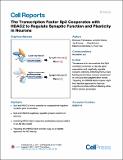
| dc.description.abstract | The histone deacetylase HDAC2, which negatively regulates synaptic gene expression and neuronal plasticity, is upregulated in Alzheimer's disease (AD) patients and mouse models. Therapeutics targeting HDAC2 hold promise for ameliorating AD-related cognitive impairment; however, attempts to generate HDAC2-specific inhibitors have failed. Here, we take an integrative genomics approach to identify proteins that mediate HDAC2 recruitment to synaptic plasticity genes. Functional screening revealed that knockdown of the transcription factor Sp3 phenocopied HDAC2 knockdown and that Sp3 facilitated recruitment of HDAC2 to synaptic genes. Importantly, like HDAC2, Sp3 expression was elevated in AD patients and mouse models, where Sp3 knockdown ameliorated synaptic dysfunction. Furthermore, exogenous expression of an HDAC2 fragment containing the Sp3-binding domain restored synaptic plasticity and memory in a mouse model with severe neurodegeneration. Our findings indicate that targeting the HDAC2-Sp3 complex could enhance cognitive function without affecting HDAC2 function in other processes. | en_US |
| dc.publisher | Elsevier | en_US |
| dc.relation.isversionof | http://dx.doi.org/10.1016/j.celrep.2017.07.044 | en_US |
| dc.rights | Creative Commons Attribution-NonCommercial-NoDerivs License | en_US |
| dc.rights.uri | http://creativecommons.org/licenses/by-nc-nd/4.0/ | en_US |
| dc.source | Elsevier | en_US |
| dc.title | The Transcription Factor Sp3 Cooperates with HDAC2 to Regulate Synaptic Function and Plasticity in Neurons | en_US |
| dc.type | Article | en_US |
| dc.identifier.citation | Yamakawa, Hidekuni et al. “The Transcription Factor Sp3 Cooperates with HDAC2 to Regulate Synaptic Function and Plasticity in Neurons.” Cell Reports 20, 6 (August 2017): 1319–1334 © 2017 The Authors | en_US |
| dc.contributor.department | Massachusetts Institute of Technology. Department of Brain and Cognitive Sciences | en_US |
| dc.contributor.department | Picower Institute for Learning and Memory | en_US |
| dc.contributor.mitauthor | Yamakawa, Hidekuni | |
| dc.contributor.mitauthor | Cheng, Jemmie | |
| dc.contributor.mitauthor | Penney, Jay | |
| dc.contributor.mitauthor | Gao, Fan | |
| dc.contributor.mitauthor | Rueda IV, Richard | |
| dc.contributor.mitauthor | Wang, Jun | |
| dc.contributor.mitauthor | Yamakawa, Satoko | |
| dc.contributor.mitauthor | Kritskiy, Oleg | |
| dc.contributor.mitauthor | Gjoneska, Elizabeta | |
| dc.contributor.mitauthor | Tsai, Li-Huei | |
| dc.relation.journal | Cell Reports | en_US |
| dc.eprint.version | Final published version | en_US |
| dc.type.uri | http://purl.org/eprint/type/JournalArticle | en_US |
| eprint.status | http://purl.org/eprint/status/PeerReviewed | en_US |
| dc.date.updated | 2017-12-11T12:55:03Z | |
| dspace.orderedauthors | Yamakawa, Hidekuni; Cheng, Jemmie; Penney, Jay; Gao, Fan; Rueda, Richard; Wang, Jun; Yamakawa, Satoko; Kritskiy, Oleg; Gjoneska, Elizabeta; Tsai, Li-Huei | en_US |
| dspace.embargo.terms | N | en_US |
| dc.identifier.orcid | https://orcid.org/0000-0003-4000-8827 | |
| dc.identifier.orcid | https://orcid.org/0000-0001-5607-113X | |
| dc.identifier.orcid | https://orcid.org/0000-0002-0591-5993 | |
| dc.identifier.orcid | https://orcid.org/0000-0002-3255-4740 | |
| dc.identifier.orcid | https://orcid.org/0000-0003-1262-0592 | |
| mit.license | PUBLISHER_CC | en_US |