| dc.contributor.author | Chandrasekaran, Sriram | |
| dc.contributor.author | Zhang, Jin | |
| dc.contributor.author | Sun, Zhen | |
| dc.contributor.author | Zhang, Li | |
| dc.contributor.author | Ross, Christian A. | |
| dc.contributor.author | Huang, Yu-Chung | |
| dc.contributor.author | Asara, John M. | |
| dc.contributor.author | Li, Hu | |
| dc.contributor.author | Daley, George Q. | |
| dc.contributor.author | Collins, James J. | |
| dc.date.accessioned | 2018-01-23T15:33:20Z | |
| dc.date.available | 2018-01-23T15:33:20Z | |
| dc.date.issued | 2017-12 | |
| dc.date.submitted | 2017-05 | |
| dc.identifier.issn | 2211-1247 | |
| dc.identifier.uri | http://hdl.handle.net/1721.1/113270 | |
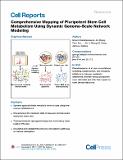
| dc.description.abstract | Metabolism is an emerging stem cell hallmark tied to cell fate, pluripotency, and self-renewal, yet systems-level understanding of stem cell metabolism has been limited by the lack of genome-scale network models. Here, we develop a systems approach to integrate time-course metabolomics data with a computational model of metabolism to analyze the metabolic state of naive and primed murine pluripotent stem cells. Using this approach, we find that one-carbon metabolism involving phosphoglycerate dehydrogenase, folate synthesis, and nucleotide synthesis is a key pathway that differs between the two states, resulting in differential sensitivity to anti-folates. The model also predicts that the pluripotency factor Lin28 regulates this one-carbon metabolic pathway, which we validate using metabolomics data from Lin28-deficient cells. Moreover, we identify and validate metabolic reactions related to S-adenosyl-methionine production that can differentially impact histone methylation in naive and primed cells. Our network-based approach provides a framework for characterizing metabolic changes influencing pluripotency and cell fate. Chandrasekaran et al. use computational modeling, metabolomics, and metabolic inhibitors to discover metabolic differences between various pluripotent stem cell states and infer their impact on stem cell fate decisions. Keywords: systems biology; stem cell biology; metabolism; genome-scale modeling; pluripotency; histone methylation; naive (ground) state; primed state; cell fate; metabolic network | en_US |
| dc.publisher | Elsevier | en_US |
| dc.relation.isversionof | http://dx.doi.org/10.1016/j.celrep.2017.07.048 | en_US |
| dc.rights | Creative Commons Attribution 4.0 International License | en_US |
| dc.rights.uri | http://creativecommons.org/licenses/by/4.0 | en_US |
| dc.source | Cell Reports | en_US |
| dc.title | Comprehensive Mapping of Pluripotent Stem Cell Metabolism Using Dynamic Genome-Scale Network Modeling | en_US |
| dc.type | Article | en_US |
| dc.identifier.citation | Chandrasekaran, Sriram et al. “Comprehensive Mapping of Pluripotent Stem Cell Metabolism Using Dynamic Genome-Scale Network Modeling.” Cell Reports 21, 10 (December 2017): 2965–2977 © 2017 The Authors | en_US |
| dc.contributor.department | Institute for Medical Engineering and Science | en_US |
| dc.contributor.department | Massachusetts Institute of Technology. Department of Biological Engineering | en_US |
| dc.contributor.department | Massachusetts Institute of Technology. Synthetic Biology Center | en_US |
| dc.contributor.mitauthor | Chandrasekaran, Sriram | |
| dc.contributor.mitauthor | Collins, James J. | |
| dc.relation.journal | Cell Reports | en_US |
| dc.eprint.version | Final published version | en_US |
| dc.type.uri | http://purl.org/eprint/type/JournalArticle | en_US |
| eprint.status | http://purl.org/eprint/status/PeerReviewed | en_US |
| dc.date.updated | 2018-01-19T19:07:34Z | |
| dspace.orderedauthors | Chandrasekaran, Sriram; Zhang, Jin; Sun, Zhen; Zhang, Li; Ross, Christian A.; Huang, Yu-Chung; Asara, John M.; Li, Hu; Daley, George Q.; Collins, James J. | en_US |
| dspace.embargo.terms | N | en_US |
| dc.identifier.orcid | https://orcid.org/0000-0002-6897-2135 | |
| dc.identifier.orcid | https://orcid.org/0000-0002-5560-8246 | |
| mit.license | PUBLISHER_CC | en_US |