| dc.contributor.author | Kwon, Byungsu | |
| dc.contributor.author | Hong, Mei | |
| dc.date.accessioned | 2018-01-29T15:30:21Z | |
| dc.date.available | 2018-01-29T15:30:21Z | |
| dc.date.issued | 2016-09 | |
| dc.date.submitted | 2016-07 | |
| dc.identifier.issn | 0006-2960 | |
| dc.identifier.issn | 1520-4995 | |
| dc.identifier.uri | http://hdl.handle.net/1721.1/113317 | |
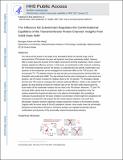
| dc.description.abstract | The influenza M2 protein is the target of the amantadine family of antiviral drugs, and its transmembrane (TM) domain structure and dynamics have been extensively studied. However, little is known about the structure of the highly conserved N-terminal ectodomain, which contains epitopes targeted by influenza vaccines. In this study, we synthesized an M2 construct containing the N-terminal ectodomain and the TM domain, to understand the site-specific conformation and dynamics of the ectodomain and to investigate the effect of the ectodomain on the TM structure. We incorporated ¹³C- and ¹⁵N-labeled residues into both domains and measured their chemical shifts and line widths using solid-state nuclear magnetic resonance. The data indicate that the entire ectodomain is unstructured and dynamic, but the motion is slower for residues closer to the TM domain. ¹³C line shapes indicate that this ecto-TM construct undergoes fast uniaxial rotational diffusion, like the isolated TM peptide, but drug binding increases the motional rates of the TM helix while slowing the local motion of the ectodomain residues that are close to the TM domain. Moreover, ¹³C and ¹⁵N chemical shifts indicate that the ectodomain shifts the conformational equilibria of the TM residues toward the drug-bound state even in the absence of amantadine, thus providing a molecular structural basis for the lower inhibitory concentration of full-length M2 compared to that of the ectodomain-truncated M2. We propose that this conformational selection may result from electrostatic repulsion between negatively charged ectodomain residues in the tetrameric protein. Together with the recent study of the M2 cytoplasmic domain, these results show that intrinsically disordered extramembrane domains in membrane proteins can regulate the functionally relevant conformation and dynamics of the structurally ordered TM domains. | en_US |
| dc.description.sponsorship | National Institutes of Health (U.S.) (Grant GM088204) | en_US |
| dc.publisher | American Chemical Society (ACS) | en_US |
| dc.relation.isversionof | http://dx.doi.org/10.1021/ACS.BIOCHEM.6B00727 | en_US |
| dc.rights | Article is made available in accordance with the publisher's policy and may be subject to US copyright law. Please refer to the publisher's site for terms of use. | en_US |
| dc.source | PMC | en_US |
| dc.title | The Influenza M2 Ectodomain Regulates the Conformational Equilibria of the Transmembrane Proton Channel: Insights from Solid-State Nuclear Magnetic Resonance | en_US |
| dc.type | Article | en_US |
| dc.identifier.citation | Kwon, Byungsu, and Hong, Mei. “The Influenza M2 Ectodomain Regulates the Conformational Equilibria of the Transmembrane Proton Channel: Insights from Solid-State Nuclear Magnetic Resonance.” Biochemistry 55, 38 (September 2016): 5387–5397 © 2016 American Chemical Society | en_US |
| dc.contributor.department | Massachusetts Institute of Technology. Department of Chemistry | en_US |
| dc.contributor.mitauthor | Kwon, Byungsu | |
| dc.contributor.mitauthor | Hong, Mei | |
| dc.relation.journal | Biochemistry | en_US |
| dc.eprint.version | Author's final manuscript | en_US |
| dc.type.uri | http://purl.org/eprint/type/JournalArticle | en_US |
| eprint.status | http://purl.org/eprint/status/PeerReviewed | en_US |
| dc.date.updated | 2018-01-25T19:40:51Z | |
| dspace.orderedauthors | Kwon, Byungsu; Hong, Mei | en_US |
| dspace.embargo.terms | N | en_US |
| dc.identifier.orcid | https://orcid.org/0000-0002-1567-9672 | |
| dc.identifier.orcid | https://orcid.org/0000-0001-5255-5858 | |
| mit.license | PUBLISHER_POLICY | en_US |