| dc.contributor.author | Liu, Yang | |
| dc.contributor.author | Ye, Qing | |
| dc.contributor.author | Peng, Jian | |
| dc.contributor.author | Palmedo, Peter Franklin | |
| dc.contributor.author | Berger Leighton, Bonnie | |
| dc.date.accessioned | 2018-05-16T13:26:52Z | |
| dc.date.available | 2018-05-16T13:26:52Z | |
| dc.date.issued | 2017-12 | |
| dc.date.submitted | 2017-10 | |
| dc.identifier.issn | 2405-4712 | |
| dc.identifier.uri | http://hdl.handle.net/1721.1/115385 | |
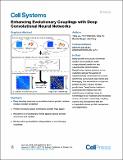
| dc.description.abstract | While genes are defined by sequence, in biological systems a protein's function is largely determined by its three-dimensional structure. Evolutionary information embedded within multiple sequence alignments provides a rich source of data for inferring structural constraints on macromolecules. Still, many proteins of interest lack sufficient numbers of related sequences, leading to noisy, error-prone residue-residue contact predictions. Here we introduce DeepContact, a convolutional neural network (CNN)-based approach that discovers co-evolutionary motifs and leverages these patterns to enable accurate inference of contact probabilities, particularly when few related sequences are available. DeepContact significantly improves performance over previous methods, including in the CASP12 blind contact prediction task where we achieved top performance with another CNN-based approach. Moreover, our tool converts hard-to-interpret coupling scores into probabilities, moving the field toward a consistent metric to assess contact prediction across diverse proteins. Through substantially improving the precision-recall behavior of contact prediction, DeepContact suggests we are near a paradigm shift in template-free modeling for protein structure prediction. Many protein structures of interest remain out of reach for both computational prediction and experimental determination. DeepContact learns patterns of co-evolution across thousands of experimentally determined structures, identifying conserved local motifs and leveraging this information to improve protein residue-residue contact predictions. DeepContact extracts additional information from the evolutionary couplings using its knowledge of co-evolution and structural space, while also converting coupling scores into probabilities that are comparable across protein sequences and alignments. Keywords: contact prediction; convolutional neural networks;
deep learning; protein structure prediction; structure prediction; co-evolution; evolutionary couplings | en_US |
| dc.description.sponsorship | National Institutes of Health (U.S.) (Grant R01GM081871) | en_US |
| dc.publisher | Elsevier | en_US |
| dc.relation.isversionof | http://dx.doi.org/10.1016/J.CELS.2017.11.014 | en_US |
| dc.rights | Creative Commons Attribution-NonCommercial-NoDerivs License | en_US |
| dc.rights.uri | http://creativecommons.org/licenses/by-nc-nd/4.0/ | en_US |
| dc.source | Elsevier | en_US |
| dc.title | Enhancing Evolutionary Couplings with Deep Convolutional Neural Networks | en_US |
| dc.type | Article | en_US |
| dc.identifier.citation | Liu, Yang et al. “Enhancing Evolutionary Couplings with Deep Convolutional Neural Networks.” Cell Systems 6, 1 (January 2018): 65–74 © 2017 The Authors | en_US |
| dc.contributor.department | Massachusetts Institute of Technology. Computer Science and Artificial Intelligence Laboratory | en_US |
| dc.contributor.department | Massachusetts Institute of Technology. Department of Electrical Engineering and Computer Science | en_US |
| dc.contributor.department | Massachusetts Institute of Technology. Department of Mathematics | en_US |
| dc.contributor.mitauthor | Palmedo, Peter Franklin | |
| dc.contributor.mitauthor | Berger Leighton, Bonnie | |
| dc.relation.journal | Cell Systems | en_US |
| dc.eprint.version | Final published version | en_US |
| dc.type.uri | http://purl.org/eprint/type/JournalArticle | en_US |
| eprint.status | http://purl.org/eprint/status/PeerReviewed | en_US |
| dc.date.updated | 2018-05-15T18:41:59Z | |
| dspace.orderedauthors | Liu, Yang; Palmedo, Perry; Ye, Qing; Berger, Bonnie; Peng, Jian | en_US |
| dspace.embargo.terms | N | en_US |
| dc.identifier.orcid | https://orcid.org/0000-0002-2724-7228 | |
| mit.license | PUBLISHER_CC | en_US |