| dc.contributor.author | Shajii, Ariya | |
| dc.contributor.author | Numanagic, Ibrahim | |
| dc.contributor.author | Whelan, Christopher | |
| dc.contributor.author | Berger Leighton, Bonnie | |
| dc.date.accessioned | 2019-11-14T19:12:22Z | |
| dc.date.available | 2019-11-14T19:12:22Z | |
| dc.date.issued | 2018-08 | |
| dc.identifier.issn | 2405-4712 | |
| dc.identifier.uri | https://hdl.handle.net/1721.1/122938 | |
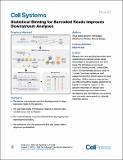
| dc.description.abstract | Sequencing technologies are capturing longer-range genomic information at lower error rates, enabling alignment to genomic regions that are inaccessible with short reads. However, many methods are unable to align reads to much of the genome, recognized as important in disease, and thus report erroneous results in downstream analyses. We introduce EMA, a novel two-tiered statistical binning model for barcoded read alignment, that first probabilistically maps reads to potentially multiple “read clouds” and then within clouds by newly exploiting the non-uniform read densities characteristic of barcoded read sequencing. EMA substantially improves downstream accuracy over existing methods, including phasing and genotyping on 10x data, with fewer false variant calls in nearly half the time. EMA effectively resolves particularly challenging alignments in genomic regions that contain nearby homologous elements, uncovering variants in the pharmacogenomically important CYP2D region, and clinically important genes C4 (schizophrenia) and AMY1A (obesity), which go undetected by existing methods. Our work provides a framework for future generation sequencing. Researchers are applying barcoded read sequencing to capture longer-range information in the genome at low error rates. We introduce a two-tiered statistical binning model, named EMA, which probabilistically assigns reads to “clouds” and then optimizes read assignments within clouds based on read densities. Unlike previous approaches, our efficient method enables alignment to highly homologous regions of the genome important in disease and substantially improves downstream genotyping and haplotyping. Our method also uncovers rare variants in clinically important genes. Keywords: third-generation sequencing; read mapping; barcoded short-reads; linked-reads | en_US |
| dc.description.sponsorship | National Institutes of Health (U.S.) (Grant GM108348) | en_US |
| dc.language.iso | en | |
| dc.publisher | Elsevier BV | en_US |
| dc.relation.isversionof | http://dx.doi.org/10.1016/j.cels.2018.07.005 | en_US |
| dc.rights | Creative Commons Attribution-NonCommercial-NoDerivs License | en_US |
| dc.rights.uri | http://creativecommons.org/licenses/by-nc-nd/4.0/ | en_US |
| dc.source | Elsevier | en_US |
| dc.title | Statistical Binning for Barcoded Reads Improves Downstream Analyses | en_US |
| dc.type | Article | en_US |
| dc.identifier.citation | Shajii, Ariya et al. "Statistical Binning for Barcoded Reads Improves Downstream Analyses." Cell Systems 7, 2 (2018): 219-226 © 2018 The Author(s) | en_US |
| dc.contributor.department | Massachusetts Institute of Technology. Computer Science and Artificial Intelligence Laboratory | en_US |
| dc.contributor.department | Massachusetts Institute of Technology. Department of Mathematics | en_US |
| dc.relation.journal | Cell Systems | en_US |
| dc.eprint.version | Final published version | en_US |
| dc.type.uri | http://purl.org/eprint/type/JournalArticle | en_US |
| eprint.status | http://purl.org/eprint/status/PeerReviewed | en_US |
| dc.date.updated | 2019-11-07T19:02:19Z | |
| dspace.date.submission | 2019-11-07T19:02:23Z | |
| mit.journal.volume | 7 | en_US |
| mit.journal.issue | 2 | en_US |