| dc.contributor.author | Ngo, Le P | |
| dc.contributor.author | Ge, Jing | |
| dc.contributor.author | Samson, Leona D | |
| dc.contributor.author | Engelward, Bevin P | |
| dc.date.accessioned | 2020-04-23T12:02:51Z | |
| dc.date.available | 2020-04-23T12:02:51Z | |
| dc.date.issued | 2019-02 | |
| dc.identifier.issn | 2211-1247 | |
| dc.identifier.uri | https://hdl.handle.net/1721.1/124826 | |
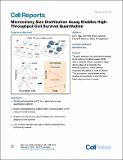
| dc.description.abstract | Cell survival is a critical and ubiquitous endpoint inbiology. The broadly accepted colony formationassay (CFA) directly measures a cell’s ability to divide;however, it takes weeks to perform and is incompat-ible with high-throughput screening (HTS) technolo-gies. Here, we describe the MicroColonyChip, whichexploits microwell array technology to create an arrayof colonies. Unlike the CFA, where visible coloniesare counted by eye, using fluorescence microscopy,microcolonies can be analyzed in days rather thanweeks. Using automated analysis of microcolonysize distributions, the MicroColonyChip achievescomparable sensitivity to the CFA (and greater sensi-tivity than the 2,3-bis-(2-methoxy-4-nitro-5-sulfo-phenyl)-2H-tetrazolium-5-carboxanilide [XTT] assay).Compared to CellTiter-Glo, the MicroColonyChip isas sensitive and also robust to artifacts caused bydifferences in initial cell seeding density. We demon-strate efficacy via studies of radiosensitivity andchemosensitivity and show that the approach isamenable to multiplexing. We conclude that theMicroColonyChip is a rapid and automated alternativefor cell survival quantitation. | en_US |
| dc.description.sponsorship | National Institute of Environmental Health Sciences (Grant R44ES024698) | en_US |
| dc.description.sponsorship | National Institutes of Health (U.S.). Superfund Basic Research Program (Grant P42 ES027707) | en_US |
| dc.description.sponsorship | National Institutes of Health (U.S.) (Grant R01 ES022872) | en_US |
| dc.description.sponsorship | National Institute of Environmental Health Sciences (Grant DP1 ES022576) | en_US |
| dc.description.sponsorship | Massachusetts Institute of Technology. Center for Environmental Health Sciences (Grant P30-ES002109) | en_US |
| dc.language.iso | en | |
| dc.publisher | Elsevier BV | en_US |
| dc.relation.isversionof | 10.1016/j.celrep.2019.01.053 | en_US |
| dc.rights | Creative Commons Attribution-NonCommercial-NoDerivs License | en_US |
| dc.rights.uri | http://creativecommons.org/licenses/by-nc-nd/4.0/ | en_US |
| dc.source | Elsevier | en_US |
| dc.subject | General Biochemistry, Genetics and Molecular Biology | en_US |
| dc.title | Microcolony Size Distribution Assay Enables High-Throughput Cell Survival Quantitation | en_US |
| dc.type | Article | en_US |
| dc.identifier.citation | Ngo, Le P. et al. “Microcolony Size Distribution Assay Enables High-Throughput Cell Survival Quantitation.” Cell Reports 26 (2019): 1668-1678 © 2019 The Author(s) | en_US |
| dc.contributor.department | Massachusetts Institute of Technology. Department of Biological Engineering | en_US |
| dc.contributor.department | Massachusetts Institute of Technology. Department of Biology | en_US |
| dc.relation.journal | Cell Reports | en_US |
| dc.eprint.version | Final published version | en_US |
| dc.type.uri | http://purl.org/eprint/type/JournalArticle | en_US |
| eprint.status | http://purl.org/eprint/status/PeerReviewed | en_US |
| dc.date.updated | 2020-03-05T18:11:15Z | |
| dspace.date.submission | 2020-03-05T18:11:17Z | |
| mit.journal.volume | 26 | en_US |
| mit.journal.issue | 6 | en_US |
| mit.license | PUBLISHER_CC | |
| mit.metadata.status | Complete | |