| dc.contributor.author | Szkop, Kevin M. | |
| dc.contributor.author | Geeson, Michael B. | |
| dc.contributor.author | Stephan, Douglas W. | |
| dc.contributor.author | Cummins, Christopher C | |
| dc.date.accessioned | 2020-05-15T20:11:17Z | |
| dc.date.available | 2020-05-15T20:11:17Z | |
| dc.date.issued | 2019-02 | |
| dc.date.submitted | 2018-12 | |
| dc.identifier.issn | 2041-6520 | |
| dc.identifier.issn | 2041-6539 | |
| dc.identifier.uri | https://hdl.handle.net/1721.1/125274 | |
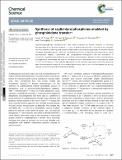
| dc.description.abstract | Acyl(chloro)phosphines RC(O)P(Cl)(t-Bu) have been prepared by formal insertion of tert-butyl phosphinidene (t-Bu-P) from t-BuPA (A = C14H10 or anthracene) into the C-Cl bond of acyl chlorides. We show that the under-explored acyl(chloro)phosphine functional group provides an efficient method to prepare bis(acyl)phosphines, which are important precursors to compounds used industrially as radical polymerization initiators. Experimental and computational investigations into the mechanism of formation of acyl(chloro)phosphines by our synthetic method reveal a pathway in which chloride attacks a phosphonium intermediate and leads to the reductive loss of anthracene from the phosphorus center in a P(v) to P(iii) process. The synthetic applicability of the acyl(chloro)phosphine functional group has been demonstrated by reduction to an acylphosphide anion, which can in turn be treated with an acyl chloride to furnish dissymmetric bis(acyl)phosphines. | en_US |
| dc.description.sponsorship | National Science Foundation (CHE-1664799) | en_US |
| dc.language.iso | en | |
| dc.publisher | Royal Society of Chemistry (RSC) | en_US |
| dc.relation.isversionof | http://dx.doi.org/10.1039/c8sc05657a | en_US |
| dc.rights | Creative Commons Attribution 3.0 unported license | en_US |
| dc.rights.uri | https://creativecommons.org/licenses/by/3.0/ | en_US |
| dc.source | Royal Society of Chemistry (RSC) | en_US |
| dc.title | Synthesis of acyl(chloro)phosphines enabled by phosphinidene transfer | en_US |
| dc.type | Article | en_US |
| dc.identifier.citation | Szkop, Kevin M. et al. "Synthesis of acyl(chloro)phosphines enabled by phosphinidene transfer." Chemical Science 10, 12 (February 2019): 3627-3631 © 2019 The Royal Society of Chemistry | en_US |
| dc.contributor.department | Massachusetts Institute of Technology. Department of Chemistry | en_US |
| dc.relation.journal | Chemical Sicence | en_US |
| dc.eprint.version | Final published version | en_US |
| dc.type.uri | http://purl.org/eprint/type/JournalArticle | en_US |
| eprint.status | http://purl.org/eprint/status/PeerReviewed | en_US |
| dc.date.updated | 2019-12-13T19:38:31Z | |
| dspace.date.submission | 2019-12-13T19:38:33Z | |
| mit.journal.volume | 10 | en_US |
| mit.journal.issue | 12 | en_US |
| mit.metadata.status | Complete | |