| dc.contributor.author | Johnston, Chad W. | |
| dc.contributor.author | Collins, James J. | |
| dc.date.accessioned | 2020-06-22T19:46:38Z | |
| dc.date.available | 2020-06-22T19:46:38Z | |
| dc.date.issued | 2019-09 | |
| dc.identifier.issn | 0036-8075 | |
| dc.identifier.issn | 1095-9203 | |
| dc.identifier.uri | https://hdl.handle.net/1721.1/125921 | |
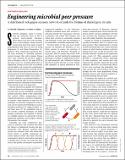
| dc.description.abstract | Synthetic biologists aspire to reengineer the molecular basis of life to perform new-to-nature functions. Their efforts have led to the development of increasingly complex genetic circuits that have been used to create programmable cells that can serve as living diagnostics (1) and living therapeutics (2). However, these engineered organisms benefit from mutating or disabling synthetic circuits because they often impose fitness costs, thus limiting the practical applications of designer cells (3). On page 1045 of this issue, Liao et al. (4) demonstrate that an engineered ecology can be used to maintain circuit fidelity and circumvent evolutionary interference. By overlaying a network of mutually exclusive gene pairs onto bacteria with a shared circuit, three engineered strains can be used to seamlessly displace each other after serial addition to a continuous culture. Iteratively removing older bacteria eliminates potential mutants, allowing the functionality of the shared circuit to be preserved. | en_US |
| dc.language.iso | en | |
| dc.publisher | American Association for the Advancement of Science (AAAS) | en_US |
| dc.relation.isversionof | http://dx.doi.org/10.1126/science.aay3157 | en_US |
| dc.rights | Creative Commons Attribution-Noncommercial-Share Alike | en_US |
| dc.rights.uri | http://creativecommons.org/licenses/by-nc-sa/4.0/ | en_US |
| dc.source | Prof. Collins via Howard Silver | en_US |
| dc.title | Engineering microbial peer pressure | en_US |
| dc.type | Article | en_US |
| dc.identifier.citation | Johnston, Chad W. and James J. Collins."Engineering microbial peer pressure." Science 365, 6457 (September 2019): 986-987 © 2019 The Authors | en_US |
| dc.contributor.department | Massachusetts Institute of Technology. Institute for Medical Engineering & Science | en_US |
| dc.contributor.department | Massachusetts Institute of Technology. Department of Biological Engineering | en_US |
| dc.relation.journal | Science | en_US |
| dc.eprint.version | Author's final manuscript | en_US |
| dc.type.uri | http://purl.org/eprint/type/JournalArticle | en_US |
| eprint.status | http://purl.org/eprint/status/PeerReviewed | en_US |
| dc.date.updated | 2020-06-22T15:59:36Z | |
| dspace.date.submission | 2020-06-22T15:59:39Z | |
| mit.journal.volume | 365 | en_US |
| mit.journal.issue | 6457 | en_US |
| mit.license | OPEN_ACCESS_POLICY | |
| mit.metadata.status | Complete | |