| dc.contributor.author | Rothenberg, Daniel Abram | |
| dc.contributor.author | Taliaferro, Jefferson Matthew | |
| dc.contributor.author | Huber, Sabrina M | |
| dc.contributor.author | Dedon, Peter C | |
| dc.contributor.author | White, Forest M. | |
| dc.date.accessioned | 2020-07-31T13:28:44Z | |
| dc.date.available | 2020-07-31T13:28:44Z | |
| dc.date.issued | 2018-11 | |
| dc.identifier.issn | 2589-0042 | |
| dc.identifier.uri | https://hdl.handle.net/1721.1/126460 | |
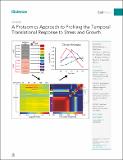
| dc.description.abstract | To quantify dynamic protein synthesis rates, we developed MITNCAT, a method combining multiplexed isobaric mass tagging with pulsed SILAC (pSILAC)and bio-orthogonal non-canonical amino acid tagging (BONCAT)to label newly synthesized proteins with azidohomoalanine (Aha), thus enabling high temporal resolution across multiple conditions in a single analysis. MITNCAT quantification of protein synthesis rates following induction of the unfolded protein response revealed global down-regulation of protein synthesis, with stronger down-regulation of glycolytic and protein synthesis machinery proteins, but up-regulation of several key chaperones. Waves of temporally distinct protein synthesis were observed in response to epidermal growth factor, with altered synthesis detectable in the first 15 min. Comparison of protein synthesis with mRNA sequencing and ribosome footprinting distinguished protein synthesis driven by increased transcription versus increased translational efficiency. Temporal delays between ribosome occupancy and protein synthesis were observed and found to correlate with altered codon usage in significantly delayed proteins. | en_US |
| dc.language.iso | en | |
| dc.publisher | Elsevier BV | en_US |
| dc.relation.isversionof | 10.1016/J.ISCI.2018.11.004 | en_US |
| dc.rights | Creative Commons Attribution 4.0 International license | en_US |
| dc.rights.uri | https://creativecommons.org/licenses/by/4.0/ | en_US |
| dc.source | Elsevier | en_US |
| dc.title | A Proteomics Approach to Profiling the Temporal Translational Response to Stress and Growth | en_US |
| dc.type | Article | en_US |
| dc.identifier.citation | Rothenberg, Daniel A. et al. “A Proteomics Approach to Profiling the Temporal Translational Response to Stress and Growth.” iScience, vol. 9, 2018, pp. 367-381 © 2018 The Author(s) | en_US |
| dc.contributor.department | Massachusetts Institute of Technology. Department of Biological Engineering | en_US |
| dc.contributor.department | Massachusetts Institute of Technology. Department of Biology | en_US |
| dc.contributor.department | Koch Institute for Integrative Cancer Research at MIT | en_US |
| dc.relation.journal | iScience | en_US |
| dc.eprint.version | Final published version | en_US |
| dc.type.uri | http://purl.org/eprint/type/JournalArticle | en_US |
| eprint.status | http://purl.org/eprint/status/PeerReviewed | en_US |
| dc.date.updated | 2020-03-05T17:08:05Z | |
| dspace.date.submission | 2020-03-05T17:08:07Z | |
| mit.journal.volume | 9 | en_US |
| mit.license | PUBLISHER_CC | |
| mit.metadata.status | Complete | |