| dc.contributor.author | Zeng, Andy | |
| dc.contributor.author | Song, Shuran | |
| dc.contributor.author | Yu, Kuan-Ting | |
| dc.contributor.author | Donlon, Elliott S | |
| dc.contributor.author | Hogan, Francois R. | |
| dc.contributor.author | Bauza Villalonga, Maria | |
| dc.contributor.author | Ma, Daolin | |
| dc.contributor.author | Taylor, Orion Thomas | |
| dc.contributor.author | Liu, Melody | |
| dc.contributor.author | Romo, Eudald | |
| dc.contributor.author | Fazeli, Nima | |
| dc.contributor.author | Alet, Ferran | |
| dc.contributor.author | Chavan Dafle, Nikhil Narsingh | |
| dc.contributor.author | Holladay, Rachel | |
| dc.contributor.author | Morena, Isabella | |
| dc.contributor.author | Qu Nair, Prem | |
| dc.contributor.author | Green, Druck | |
| dc.contributor.author | Taylor, Ian | |
| dc.contributor.author | Liu, Weber | |
| dc.contributor.author | Funkhouser, Thomas | |
| dc.contributor.author | Rodriguez, Alberto | |
| dc.date.accessioned | 2020-09-01T16:02:35Z | |
| dc.date.available | 2020-09-01T16:02:35Z | |
| dc.date.issued | 2018-09 | |
| dc.date.submitted | 2018-05 | |
| dc.identifier.isbn | 9781538630815 | |
| dc.identifier.uri | https://hdl.handle.net/1721.1/126872 | |
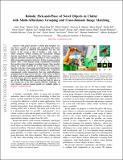
| dc.description.abstract | This paper presents a robotic pick-and-place system that is capable of grasping and recognizing both known and novel objects in cluttered environments. The key new feature of the system is that it handles a wide range of object categories without needing any task-specific training data for novel objects. To achieve this, it first uses a category-agnostic affordance prediction algorithm to select and execute among four different grasping primitive behaviors. It then recognizes picked objects with a cross-domain image classification framework that matches observed images to product images. Since product images are readily available for a wide range of objects (e.g., from the web), the system works out-of-the-box for novel objects without requiring any additional training data. Exhaustive experimental results demonstrate that our multi-affordance grasping achieves high success rates for a wide variety of objects in clutter, and our recognition algorithm achieves high accuracy for both known and novel grasped objects. The approach was part of the MIT-Princeton Team system that took 1st place in the stowing task at the 2017 Amazon Robotics Challenge. All code, datasets, and pre-trained models are available online at http://arc.cs.princeton.edu. | en_US |
| dc.description.sponsorship | NSF (Grants IIS-1251217 and VEC 1539014/1539099) | en_US |
| dc.language.iso | en | |
| dc.publisher | Institute of Electrical and Electronics Engineers (IEEE) | en_US |
| dc.relation.isversionof | http://dx.doi.org/10.1109/icra.2018.8461044 | en_US |
| dc.rights | Creative Commons Attribution-Noncommercial-Share Alike | en_US |
| dc.rights.uri | http://creativecommons.org/licenses/by-nc-sa/4.0/ | en_US |
| dc.source | arXiv | en_US |
| dc.title | Robotic Pick-and-Place of Novel Objects in Clutter with Multi-Affordance Grasping and Cross-Domain Image Matching | en_US |
| dc.type | Article | en_US |
| dc.identifier.citation | Zeng, Andy et al. "Robotic Pick-and-Place of Novel Objects in Clutter with Multi-Affordance Grasping and Cross-Domain Image Matching." IEEE International Conference on Robotics and Automation, May 2018, Brisbane, Australia, Institute of Electrical and Electronics Engineers, September 2018. © 2018 IEEE | en_US |
| dc.contributor.department | Massachusetts Institute of Technology. Computer Science and Artificial Intelligence Laboratory | en_US |
| dc.contributor.department | Massachusetts Institute of Technology. Department of Electrical Engineering and Computer Science | en_US |
| dc.contributor.department | Massachusetts Institute of Technology. Department of Mechanical Engineering | en_US |
| dc.relation.journal | IEEE International Conference on Robotics and Automation (ICRA) | en_US |
| dc.eprint.version | Original manuscript | en_US |
| dc.type.uri | http://purl.org/eprint/type/ConferencePaper | en_US |
| eprint.status | http://purl.org/eprint/status/NonPeerReviewed | en_US |
| dc.date.updated | 2020-08-03T12:54:52Z | |
| dspace.date.submission | 2020-08-03T12:54:55Z | |
| mit.license | OPEN_ACCESS_POLICY | |
| mit.metadata.status | Complete | |