| dc.contributor.author | Sangesland, Maya | |
| dc.contributor.author | Yousif, Ashraf S. | |
| dc.contributor.author | Ronsard, Larance | |
| dc.contributor.author | Kazer, Samuel Weisgurt | |
| dc.contributor.author | Zhu, Alex Lee | |
| dc.contributor.author | Gatter, G. James | |
| dc.contributor.author | Hayward, Matthew R. | |
| dc.contributor.author | Barnes, Ralston M. | |
| dc.contributor.author | Quirindongo-Crespo, Maricel | |
| dc.contributor.author | Rohrer, Daniel | |
| dc.contributor.author | Lonberg, Nils | |
| dc.contributor.author | Kwon, Douglas | |
| dc.contributor.author | Shalek, Alexander K | |
| dc.contributor.author | Lingwood, Daniel | |
| dc.date.accessioned | 2020-10-27T21:47:55Z | |
| dc.date.available | 2020-10-27T21:47:55Z | |
| dc.date.issued | 2020-08 | |
| dc.date.submitted | 2020-06 | |
| dc.identifier.issn | 2211-1247 | |
| dc.identifier.uri | https://hdl.handle.net/1721.1/128222 | |
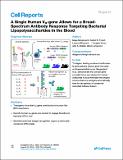
| dc.description.abstract | B cell receptors (BCRs) display a combination of variable (V)-gene-encoded complementarity determining regions (CDRs) and adaptive/hypervariable CDR3 loops to engage antigens. It has long been proposed that the former tune for recognition of pathogens or groups of pathogens. To experimentally evaluate this within the human antibody repertoire, we perform immune challenges in transgenic mice that bear diverse human CDR3 and light chains but are constrained to different human VH-genes. We find that, of six commonly deployed VH sequences, only those CDRs encoded by IGHV1-2∗02 enable polyclonal antibody responses against bacterial lipopolysaccharide (LPS) when introduced to the bloodstream. The LPS is from diverse strains of gram-negative bacteria, and the VH-gene-dependent responses are directed against the non-variable and universal saccrolipid substructure of this antigen. This reveals a broad-spectrum anti-LPS response in which germline-encoded CDRs naturally hardwire the human antibody repertoire for recognition of a conserved microbial target. | en_US |
| dc.language.iso | en | |
| dc.publisher | Elsevier BV | en_US |
| dc.relation.isversionof | http://dx.doi.org/10.1016/j.celrep.2020.108065 | en_US |
| dc.rights | Creative Commons Attribution-NonCommercial-NoDerivs License | en_US |
| dc.rights.uri | http://creativecommons.org/licenses/by-nc-nd/4.0/ | en_US |
| dc.source | Elsevier | en_US |
| dc.title | A Single Human VH-gene Allows for a Broad-Spectrum Antibody Response Targeting Bacterial Lipopolysaccharides in the Blood | en_US |
| dc.type | Article | en_US |
| dc.identifier.citation | Sangesland, Maya et al. "A Single Human VH-gene Allows for a Broad-Spectrum Antibody Response Targeting Bacterial Lipopolysaccharides in the Blood." Cell Reports 32, 8 (August 2020): 108065. © 2020 The Author(s) | en_US |
| dc.contributor.department | Massachusetts Institute of Technology. Institute for Medical Engineering & Science | en_US |
| dc.contributor.department | Massachusetts Institute of Technology. Department of Chemistry | en_US |
| dc.contributor.department | Koch Institute for Integrative Cancer Research at MIT | en_US |
| dc.relation.journal | Cell Reports | en_US |
| dc.eprint.version | Final published version | en_US |
| dc.type.uri | http://purl.org/eprint/type/JournalArticle | en_US |
| eprint.status | http://purl.org/eprint/status/PeerReviewed | en_US |
| dc.date.updated | 2020-09-21T13:36:27Z | |
| dspace.date.submission | 2020-09-21T13:36:31Z | |
| mit.journal.volume | 32 | en_US |
| mit.journal.issue | 8 | en_US |
| mit.license | PUBLISHER_CC | |
| mit.metadata.status | Complete | |