| dc.contributor.author | Dandekar, Raj | |
| dc.contributor.author | Rackauckas, Christopher V | |
| dc.contributor.author | Barbastathis, George | |
| dc.date.accessioned | 2020-12-16T15:26:10Z | |
| dc.date.available | 2020-12-16T15:26:10Z | |
| dc.date.issued | 2020-11 | |
| dc.date.submitted | 2020-09 | |
| dc.identifier.issn | 2666-3899 | |
| dc.identifier.uri | https://hdl.handle.net/1721.1/128841 | |
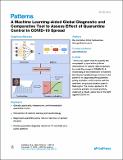
| dc.description.abstract | We have developed a globally applicable diagnostic Covid-19 model by augmenting the classical SIR epidemiological model with a neural network module. Our model does not rely upon previous epidemics like SARS/MERS and all
parameters are optimized via machine learning algorithms employed on publicly available Covid-19 data. The model decomposes the contributions to the infection timeseries to analyze and compare the role of quarantine control
policies employed in highly affected regions of Europe, North America, South America and Asia in controlling the spread of the virus. For all continents considered, our results show a generally strong correlation between strengthening of the quarantine controls as learnt by the model and actions taken by the regions' respective governments. Finally, we have hosted our quarantine diagnosis results for the top 70 affected countries worldwide, on a public platform, which can be used for informed decision making by public health officials and researchers alike. | en_US |
| dc.language.iso | en | |
| dc.publisher | Elsevier BV | en_US |
| dc.relation.isversionof | http://dx.doi.org/10.1016/j.patter.2020.100145 | en_US |
| dc.rights | Creative Commons Attribution-NonCommercial-NoDerivs License | en_US |
| dc.rights.uri | http://creativecommons.org/licenses/by-nc-nd/4.0/ | en_US |
| dc.source | Elsevier | en_US |
| dc.title | A Machine Learning-Aided Global Diagnostic and Comparative Tool to Assess Effect of Quarantine Control in COVID-19 Spread | en_US |
| dc.type | Article | en_US |
| dc.identifier.citation | Dandekar, Raj et al. "A Machine Learning-Aided Global Diagnostic and Comparative Tool to Assess Effect of Quarantine Control in COVID-19 Spread." Patterns 1, 9 (November 2020): 100145 © 2020 The Authors | en_US |
| dc.contributor.department | Massachusetts Institute of Technology. Department of Mathematics | en_US |
| dc.contributor.department | Massachusetts Institute of Technology. Department of Mechanical Engineering | en_US |
| dc.contributor.department | Massachusetts Institute of Technology. Department of Electrical Engineering and Computer Science | en_US |
| dc.contributor.department | Massachusetts Institute of Technology. Computer Science and Artificial Intelligence Laboratory | en_US |
| dc.relation.journal | Patterns | en_US |
| dc.eprint.version | Final published version | en_US |
| dc.type.uri | http://purl.org/eprint/type/JournalArticle | en_US |
| eprint.status | http://purl.org/eprint/status/PeerReviewed | en_US |
| dc.date.updated | 2020-12-16T12:47:08Z | |
| dspace.orderedauthors | Dandekar, R; Rackauckas, C; Barbastathis, G | en_US |
| dspace.date.submission | 2020-12-16T12:47:16Z | |
| mit.journal.volume | 1 | en_US |
| mit.journal.issue | 9 | en_US |
| mit.license | PUBLISHER_CC | |
| mit.metadata.status | Complete | |