| dc.contributor.author | Paranawithana, Ishara | |
| dc.contributor.author | Chau, Zhong Hoo | |
| dc.contributor.author | Yang, Liangjing | |
| dc.contributor.author | Chen, Zhong | |
| dc.contributor.author | Youcef-Toumi, Kamal | |
| dc.contributor.author | Tan, U-Xuan | |
| dc.date.accessioned | 2021-01-06T16:43:12Z | |
| dc.date.available | 2021-01-06T16:43:12Z | |
| dc.date.issued | 2019-08 | |
| dc.date.submitted | 2019-05 | |
| dc.identifier.isbn | 9781538660270 | |
| dc.identifier.issn | 2577-087X | |
| dc.identifier.uri | https://hdl.handle.net/1721.1/129074 | |
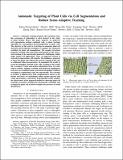
| dc.description.abstract | © 2019 IEEE. Automatic targeting of plant cells to perform tasks like extraction of chloroplast is often desired in the study of plant biology. Hence, this paper proposes an improved cell segmentation method combined with a robust tracking algorithm for vision-guided micromanipulation in plant cells. The objective of this work is to develop an automatic plant cell detection and localization technique to complete the automated workflow for plant cell manipulation. The complex structural properties of plant cells make both segmentation of cells and visual tracking of the microneedle immensely challenging, unlike single animal cell applications. Thus, an improved version of watershed segmentation with adaptive thresholding is proposed to detect the plant cells without the need for staining of the cells or additional tedious preparations. To manipulate the needle to reach the identified centroid of the cells, tracking of the needle tip is required. Visual and motion information from two data sources namely, template tracking and projected manipulator trajectory are combined using score-based normalized weighted averaging to continuously track the microneedle. The selection of trackers is influenced by their complementary nature as the former and latter are individually robust against physical and visual uncertainties, respectively. Experimental results validate the effectiveness of the proposed method by detecting plant cell centroids accurately, tracking the microneedle constantly and reaching the plant cell of interest despite the presence of visual disturbances. | en_US |
| dc.language.iso | en | |
| dc.publisher | Institute of Electrical and Electronics Engineers (IEEE) | en_US |
| dc.relation.isversionof | http://dx.doi.org/10.1109/icra.2019.8793944 | en_US |
| dc.rights | Creative Commons Attribution-Noncommercial-Share Alike | en_US |
| dc.rights.uri | http://creativecommons.org/licenses/by-nc-sa/4.0/ | en_US |
| dc.source | Other repository | en_US |
| dc.title | Automatic Targeting of Plant Cells via Cell Segmentation and Robust Scene-Adaptive Tracking | en_US |
| dc.type | Article | en_US |
| dc.identifier.citation | Paranawithana, Ishara et al. "Automatic Targeting of Plant Cells via Cell Segmentation and Robust Scene-Adaptive Tracking." IEEE International Conference on Robotics and Automation, May 2019, Montreal, Canada, Institute of Electrical and Electronics Engineers, August 2019. © 2019 IEEE | en_US |
| dc.contributor.department | Massachusetts Institute of Technology. Department of Mechanical Engineering | en_US |
| dc.relation.journal | IEEE International Conference on Robotics and Automation | en_US |
| dc.eprint.version | Author's final manuscript | en_US |
| dc.type.uri | http://purl.org/eprint/type/ConferencePaper | en_US |
| eprint.status | http://purl.org/eprint/status/NonPeerReviewed | en_US |
| dc.date.updated | 2020-08-14T13:40:28Z | |
| dspace.date.submission | 2020-08-14T13:40:32Z | |
| mit.license | OPEN_ACCESS_POLICY | |
| mit.metadata.status | Complete | |