| dc.contributor.author | Zhang, Zhekai | |
| dc.contributor.author | Wang, Hanrui | |
| dc.contributor.author | Han, Song | |
| dc.date.accessioned | 2021-01-19T14:03:23Z | |
| dc.date.available | 2021-01-19T14:03:23Z | |
| dc.date.issued | 2020-02 | |
| dc.identifier.isbn | 9781728161501 | |
| dc.identifier.uri | https://hdl.handle.net/1721.1/129436 | |
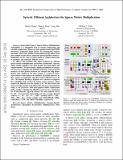
| dc.description.abstract | Generalized Sparse Matrix-Matrix Multiplication (SpGEMM) is a ubiquitous task in various engineering and scientific applications. However, inner product based SpGEMM introduces redundant input fetches for mismatched nonzero operands, while outer product based approach suffers from poor output locality due to numerous partial product matrices. Inefficiency in the reuse of either inputs or outputs data leads to extensive and expensive DRAM access. To address this problem, this paper proposes an efficient sparse matrix multiplication accelerator architecture, SpArch, which jointly optimizes the data locality for both input and output matrices. We first design a highly parallelized streaming-based merger to pipeline the multiply and merge stage of partial matrices so that partial matrices are merged on chip immediately after produced. We then propose a condensed matrix representation that reduces the number of partial matrices by three orders of magnitude and thus reduces DRAM access by 5.4x. We further develop a Huffman tree scheduler to improve the scalability of the merger for larger sparse matrices, which reduces the DRAM access by another 1.8x. We also resolve the increased input matrix read induced by the new representation using a row prefetcher with near-optimal buffer replacement policy, further reducing the DRAM access by 1.5x. Evaluated on 20 benchmarks, SpArch reduces the total DRAM access by 2.8x over previous state-of-the-art. On average, SpArch achieves 4x, 19x, 18x, 17x, 1285x speedup and 6x, 164x, 435x, 307x, 62x energy savings over OuterSpace, MKL, cuSPARSE, CUSP, and ARM Armadillo, respectively. | en_US |
| dc.description.sponsorship | National Science Foundation (U.S.). Harnessing the Data Revolution (Award 1934700) | en_US |
| dc.language.iso | en | |
| dc.publisher | Institute of Electrical and Electronics Engineers (IEEE) | en_US |
| dc.relation.isversionof | 10.1109/HPCA47549.2020.00030 | en_US |
| dc.rights | Creative Commons Attribution-Noncommercial-Share Alike | en_US |
| dc.rights.uri | http://creativecommons.org/licenses/by-nc-sa/4.0/ | en_US |
| dc.source | arXiv | en_US |
| dc.title | SpArch: Efficient Architecture for Sparse Matrix Multiplication | en_US |
| dc.type | Article | en_US |
| dc.identifier.citation | Zhang, Zhekai et al. “SpArch: Efficient Architecture for Sparse Matrix Multiplication.” Paper presented at the 2020 IEEE International Symposium on High Performance Computer Architecture, HPCA 2020, San Diego, CA, February 22-26, 2020, IEEE © 2019 The Author(s) | en_US |
| dc.contributor.department | Massachusetts Institute of Technology. Department of Electrical Engineering and Computer Science | en_US |
| dc.relation.journal | Proceedings - 2020 IEEE International Symposium on High Performance Computer Architecture, HPCA 2020 | en_US |
| dc.eprint.version | Author's final manuscript | en_US |
| dc.type.uri | http://purl.org/eprint/type/ConferencePaper | en_US |
| eprint.status | http://purl.org/eprint/status/NonPeerReviewed | en_US |
| dc.date.updated | 2020-12-17T17:09:39Z | |
| dspace.orderedauthors | Zhang, Z; Wang, H; Han, S; Dally, WJ | en_US |
| dspace.date.submission | 2020-12-17T17:09:41Z | |
| mit.license | OPEN_ACCESS_POLICY | |
| mit.metadata.status | Complete | |