| dc.contributor.author | Chen, Long | |
| dc.contributor.author | Alshawabkeh, Akram N | |
| dc.contributor.author | Hojabri, Shayan | |
| dc.contributor.author | Sun, Meng | |
| dc.contributor.author | Xu, Guiyin | |
| dc.contributor.author | Li, Ju | |
| dc.date.accessioned | 2021-10-27T19:51:40Z | |
| dc.date.available | 2021-10-27T19:51:40Z | |
| dc.date.issued | 2021 | |
| dc.identifier.uri | https://hdl.handle.net/1721.1/133236 | |
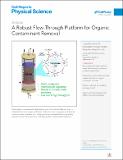
| dc.description.abstract | © 2020 The Authors Achieving the greatest cleanup efficiency with minimal footprint remains a paramount goal of the water treatment industry. Toxic organic compounds threaten drinking water safety and require effective pretreatment. Hydroxyl radicals produced by the Fenton process (Fe2+/H2O2) destroy organic contaminants based on their strong oxidation potential. An upgraded reaction using solid catalysts, referred to as the Fenton-like process, was recently adopted to avoid the ferric sludge generation during the conventional Fenton process. However, most heterogeneous Fenton-like catalysts operate optimally at pH 3–5 and quite weakly in near-neutral water bodies. Here, we evaluate the feasibility of an electrolytically localized acid compartment (referred to as the Ella process) produced by electrochemical water splitting under flow-through conditions to facilitate the Fenton-like process. The Ella process boosts the activity of an immobilized iron oxychloride catalyst >10-fold, decomposing organic pollutants at a high flow rate. The robust performance in complex water bodies further highlights the promise of this platform. | en_US |
| dc.language.iso | en | |
| dc.publisher | Elsevier BV | en_US |
| dc.relation.isversionof | 10.1016/J.XCRP.2020.100296 | en_US |
| dc.rights | Creative Commons Attribution 4.0 International license | en_US |
| dc.rights.uri | https://creativecommons.org/licenses/by/4.0/ | en_US |
| dc.source | Elsevier | en_US |
| dc.title | A Robust Flow-Through Platform for Organic Contaminant Removal | en_US |
| dc.type | Article | en_US |
| dc.contributor.department | Massachusetts Institute of Technology. Department of Nuclear Science and Engineering | |
| dc.contributor.department | Massachusetts Institute of Technology. Department of Materials Science and Engineering | |
| dc.relation.journal | Cell Reports Physical Science | en_US |
| dc.eprint.version | Final published version | en_US |
| dc.type.uri | http://purl.org/eprint/type/JournalArticle | en_US |
| eprint.status | http://purl.org/eprint/status/PeerReviewed | en_US |
| dc.date.updated | 2021-08-12T14:49:52Z | |
| dspace.orderedauthors | Chen, L; Alshawabkeh, AN; Hojabri, S; Sun, M; Xu, G; Li, J | en_US |
| dspace.date.submission | 2021-08-12T14:49:54Z | |
| mit.journal.volume | 2 | en_US |
| mit.journal.issue | 1 | en_US |
| mit.license | PUBLISHER_CC | |
| mit.metadata.status | Authority Work and Publication Information Needed | |