| dc.contributor.author | Myers, Samuel A | |
| dc.contributor.author | Rhoads, Andrew | |
| dc.contributor.author | Cocco, Alexandra R | |
| dc.contributor.author | Peckner, Ryan | |
| dc.contributor.author | Haber, Adam L | |
| dc.contributor.author | Schweitzer, Lawrence D | |
| dc.contributor.author | Krug, Karsten | |
| dc.contributor.author | Mani, DR | |
| dc.contributor.author | Clauser, Karl R | |
| dc.contributor.author | Rozenblatt-Rosen, Orit | |
| dc.contributor.author | Hacohen, Nir | |
| dc.contributor.author | Regev, Aviv | |
| dc.contributor.author | Carr, Steven A | |
| dc.date.accessioned | 2021-10-27T19:58:22Z | |
| dc.date.available | 2021-10-27T19:58:22Z | |
| dc.date.issued | 2019 | |
| dc.identifier.uri | https://hdl.handle.net/1721.1/134152 | |
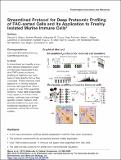
| dc.description.abstract | © 2019 Myers et al. Published under exclusive license by The American Society for Biochemistry and Molecular Biology, Inc. Proteomic profiling describes the molecular landscape of proteins in cells immediately available to sense, transduce, and enact the appropriate responses to extracellular queues. Transcriptional profiling has proven invaluable to our understanding of cellular responses; however, insights may be lost as mounting evidence suggests transcript levels only moderately correlate with protein levels in steady state cells. Mass spectrometry-based quantitative proteomics is a well-suited and widely used analytical tool for studying global protein abundances. Typical proteomic workflows are often limited by the amount of sample input that is required for deep and quantitative proteome profiling. This is especially true if the cells of interest need to be purified by fluorescence-activated cell sorting (FACS) and one wants to avoid ex vivo culturing. To address this need, we developed an easy to implement, streamlined workflow that enables quantitative proteome profiling from roughly 2 g of protein input per experimental condition. Utilizing a combination of facile cell collection from cell sorting, solid-state isobaric labeling and multiplexing of peptides, and small-scale fractionation, we profiled the proteomes of 12 freshly isolated, primary murine immune cell types. Analyzing half of the 3e5 cells collected per cell type, we quantified over 7000 proteins across 12 key immune cell populations directly from their resident tissues. We show that low input proteomics is precise, and the data generated accurately reflects many aspects of known immunology, while expanding the list of cell-type specific proteins across the cell types profiled. The low input proteomics methods we developed are readily adaptable and broadly applicable to any cell or sample types and should enable proteome profiling in systems previously unattainable. | |
| dc.language.iso | en | |
| dc.publisher | Elsevier BV | |
| dc.relation.isversionof | 10.1074/MCP.RA118.001259 | |
| dc.rights | Creative Commons Attribution 4.0 International license | |
| dc.rights.uri | https://creativecommons.org/licenses/by/4.0/ | |
| dc.source | Elsevier | |
| dc.title | Streamlined Protocol for Deep Proteomic Profiling of FAC-sorted Cells and Its Application to Freshly Isolated Murine Immune Cells* | |
| dc.type | Article | |
| dc.contributor.department | Massachusetts Institute of Technology. Department of Biology | |
| dc.contributor.department | Howard Hughes Medical Institute | |
| dc.contributor.department | Koch Institute for Integrative Cancer Research at MIT | |
| dc.relation.journal | Molecular and Cellular Proteomics | |
| dc.eprint.version | Final published version | |
| dc.type.uri | http://purl.org/eprint/type/JournalArticle | |
| eprint.status | http://purl.org/eprint/status/PeerReviewed | |
| dc.date.updated | 2021-07-22T16:49:36Z | |
| dspace.orderedauthors | Myers, SA; Rhoads, A; Cocco, AR; Peckner, R; Haber, AL; Schweitzer, LD; Krug, K; Mani, DR; Clauser, KR; Rozenblatt-Rosen, O; Hacohen, N; Regev, A; Carr, SA | |
| dspace.date.submission | 2021-07-22T16:49:38Z | |
| mit.journal.volume | 18 | |
| mit.journal.issue | 5 | |
| mit.license | PUBLISHER_CC | |
| mit.metadata.status | Authority Work and Publication Information Needed | |