Notice
This is not the latest version of this item. The latest version can be found at:https://dspace.mit.edu/handle/1721.1/134857.2
Material Viscoelastic Properties Modulate the Mesenchymal Stem Cell Secretome for Applications in Hematopoietic Recovery
| dc.contributor.author | Liu, Frances D | |
| dc.contributor.author | Pishesha, Novalia | |
| dc.contributor.author | Poon, Zhiyong | |
| dc.contributor.author | Kaushik, Tanwi | |
| dc.contributor.author | Van Vliet, Krystyn J | |
| dc.date.accessioned | 2021-10-27T20:09:30Z | |
| dc.date.available | 2021-10-27T20:09:30Z | |
| dc.date.issued | 2017 | |
| dc.identifier.uri | https://hdl.handle.net/1721.1/134857 | |
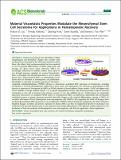
| dc.description.abstract | © 2017 American Chemical Society. Human mesenchymal stem cells (MSCs) exhibit morphological and phenotypic changes that correlate with mechanical cues presented by the substratum material to which those cells adhere. Such mechanosensitivity has been explored in vitro to promote differentiation of MSCs along tissue cell lineages for direct tissue repair. However, MSCs are increasingly understood to facilitate indirect tissue repair in vivo through paracrine signaling via secreted biomolecules. Here we leveraged cell-material interactions in vitro to induce human bone marrow-derived MSCs to preferentially secrete factors that are beneficial to hematopoietic cell proliferation. Specifically, we varied the viscoelastic properties of cell-culture-compatible polydimethylsiloxane (PDMS) substrata to demonstrate modulated MSC expression of biomolecules, including osteopontin, a secreted phosphoprotein implicated in tissue repair and regeneration. We observed an approximately 3-fold increase in expression of osteopontin for MSCs on PDMS substrata of lowest stiffness (elastic moduli <1 kPa) and highest ratio of loss modulus to storage modulus (tan(δ) > 1). A specific subpopulation of these cells, shown previously to express increased osteopontin in vitro and to promote bone marrow recovery in vivo, also exhibited up to a 5-fold increase in osteopontin expression when grown on compliant PDMS relative to heterogeneous MSCs on polystyrene. Importantly, this mechanically modulated increase in protein expression preceded detectable changes in the terminal differentiation capacity of MSCs. In coculture with human CD34+ hematopoietic stem and progenitor cells (HSPCs) that repopulate the blood cell lineages, these mechanically modulated MSCs promoted in vitro proliferation of HSPCs without altering the multipotency for either myeloid or lymphoid lineages. Cytokine and protein expression by human MSCs can thus be manipulated directly by mechanical cues conferred by the material substrata prior to and instead of tissue lineage differentiation. This approach enables enhanced in vitro production of both mesenchymal and hematopoietic stem and progenitor cells that aid regenerative clinical applications. | |
| dc.language.iso | en | |
| dc.publisher | American Chemical Society (ACS) | |
| dc.relation.isversionof | 10.1021/ACSBIOMATERIALS.7B00644 | |
| dc.rights | Article is made available in accordance with the publisher's policy and may be subject to US copyright law. Please refer to the publisher's site for terms of use. | |
| dc.source | MIT web domain | |
| dc.title | Material Viscoelastic Properties Modulate the Mesenchymal Stem Cell Secretome for Applications in Hematopoietic Recovery | |
| dc.type | Article | |
| dc.relation.journal | ACS Biomaterials Science & Engineering | |
| dc.eprint.version | Author's final manuscript | |
| dc.type.uri | http://purl.org/eprint/type/JournalArticle | |
| eprint.status | http://purl.org/eprint/status/PeerReviewed | |
| dc.date.updated | 2019-09-24T17:50:29Z | |
| dspace.orderedauthors | Liu, FD; Pishesha, N; Poon, Z; Kaushik, T; Van Vliet, KJ | |
| dspace.date.submission | 2019-09-24T17:50:32Z | |
| mit.journal.volume | 3 | |
| mit.journal.issue | 12 | |
| mit.metadata.status | Authority Work and Publication Information Needed |