| dc.contributor.author | Gerosa, Luca | |
| dc.contributor.author | Chidley, Christopher | |
| dc.contributor.author | Fröhlich, Fabian | |
| dc.contributor.author | Sanchez, Gabriela | |
| dc.contributor.author | Lim, Sang Kyun | |
| dc.contributor.author | Muhlich, Jeremy | |
| dc.contributor.author | Chen, Jia-Yun | |
| dc.contributor.author | Vallabhaneni, Sreeram | |
| dc.contributor.author | Baker, Gregory J | |
| dc.contributor.author | Schapiro, Denis | |
| dc.contributor.author | Atanasova, Mariya I | |
| dc.contributor.author | Chylek, Lily A | |
| dc.contributor.author | Shi, Tujin | |
| dc.contributor.author | Yi, Lian | |
| dc.contributor.author | Nicora, Carrie D | |
| dc.contributor.author | Claas, Allison | |
| dc.contributor.author | Ng, Thomas SC | |
| dc.contributor.author | Kohler, Rainer H | |
| dc.contributor.author | Lauffenburger, Douglas A | |
| dc.contributor.author | Weissleder, Ralph | |
| dc.contributor.author | Miller, Miles A | |
| dc.contributor.author | Qian, Wei-Jun | |
| dc.contributor.author | Wiley, H Steven | |
| dc.contributor.author | Sorger, Peter K | |
| dc.date.accessioned | 2021-10-27T20:31:01Z | |
| dc.date.available | 2021-10-27T20:31:01Z | |
| dc.date.issued | 2020 | |
| dc.identifier.uri | https://hdl.handle.net/1721.1/136137 | |
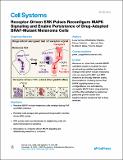
| dc.description.abstract | © 2020 The Authors Targeted inhibition of oncogenic pathways can be highly effective in halting the rapid growth of tumors but often leads to the emergence of slowly dividing persister cells, which constitute a reservoir for the selection of drug-resistant clones. In BRAFV600E melanomas, RAF and MEK inhibitors efficiently block oncogenic signaling, but persister cells emerge. Here, we show that persister cells escape drug-induced cell-cycle arrest via brief, sporadic ERK pulses generated by transmembrane receptors and growth factors operating in an autocrine/paracrine manner. Quantitative proteomics and computational modeling show that ERK pulsing is enabled by rewiring of mitogen-activated protein kinase (MAPK) signaling: from an oncogenic BRAFV600E monomer-driven configuration that is drug sensitive to a receptor-driven configuration that involves Ras-GTP and RAF dimers and is highly resistant to RAF and MEK inhibitors. Altogether, this work shows that pulsatile MAPK activation by factors in the microenvironment generates a persistent population of melanoma cells that rewires MAPK signaling to sustain non-genetic drug resistance. Gerosa et al. show that pulsatile MAPK activation makes it possible for slow-growing drug-resistant persisters to emerge when BRAF-mutant melanoma cells are exposed to RAF and MEK inhibitors at clinically relevant doses. Computational modeling shows that MAPK signaling exists in two configurations, one activated by oncogenic BRAF that is drug sensitive and the other activated by autocrine/paracrine growth factors and transmembrane receptors that is drug resistant. | en_US |
| dc.language.iso | en | |
| dc.publisher | Elsevier BV | en_US |
| dc.relation.isversionof | 10.1016/J.CELS.2020.10.002 | en_US |
| dc.rights | Creative Commons Attribution 4.0 International license | en_US |
| dc.rights.uri | https://creativecommons.org/licenses/by/4.0/ | en_US |
| dc.source | Elsevier | en_US |
| dc.title | Receptor-Driven ERK Pulses Reconfigure MAPK Signaling and Enable Persistence of Drug-Adapted BRAF-Mutant Melanoma Cells | en_US |
| dc.type | Article | en_US |
| dc.contributor.department | Massachusetts Institute of Technology. Department of Biological Engineering | |
| dc.relation.journal | Cell Systems | en_US |
| dc.eprint.version | Final published version | en_US |
| dc.type.uri | http://purl.org/eprint/type/JournalArticle | en_US |
| eprint.status | http://purl.org/eprint/status/PeerReviewed | en_US |
| dc.date.updated | 2021-09-07T17:15:52Z | |
| dspace.orderedauthors | Gerosa, L; Chidley, C; Fröhlich, F; Sanchez, G; Lim, SK; Muhlich, J; Chen, J-Y; Vallabhaneni, S; Baker, GJ; Schapiro, D; Atanasova, MI; Chylek, LA; Shi, T; Yi, L; Nicora, CD; Claas, A; Ng, TSC; Kohler, RH; Lauffenburger, DA; Weissleder, R; Miller, MA; Qian, W-J; Wiley, HS; Sorger, PK | en_US |
| dspace.date.submission | 2021-09-07T17:15:55Z | |
| mit.journal.volume | 11 | en_US |
| mit.journal.issue | 5 | en_US |
| mit.license | PUBLISHER_CC | |
| mit.metadata.status | Authority Work and Publication Information Needed | en_US |