| dc.contributor.author | Lee, Jongwoo | |
| dc.contributor.author | Warren, Haley R | |
| dc.contributor.author | Agarwal, Vibha | |
| dc.contributor.author | Huber, Meghan E | |
| dc.contributor.author | Hogan, Neville | |
| dc.date.accessioned | 2022-03-30T17:10:27Z | |
| dc.date.available | 2022-03-30T17:10:27Z | |
| dc.date.issued | 2020 | |
| dc.identifier.uri | https://hdl.handle.net/1721.1/141413 | |
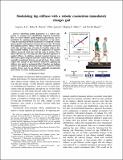
| dc.description.abstract | © 2020 IEEE. Restoring healthy kinematics is a critical component of assisting and rehabilitating impaired locomotion. Here we tested whether spatiotemporal gait patterns can be modulated by applying mechanical impedance to hip joints. Using the Samsung GEMS-H exoskeleton, we emulated a virtual spring (positive and negative) between the user's legs. We found that applying positive stiffness with the exoskeleton decreased stride time and hip range of motion for healthy subjects during treadmill walking. Conversely, the application of negative stiffness increased stride time and hip range of motion. These effects did not vary over long nor short repeated exposures to applied stiffness. In addition, minimal transient behavior was observed in spatiotemporal measures of gait when the stiffness controller transitioned between on and off states. These results suggest that changes in gait behavior induced by applying hip stiffness were purely a mechanical effect. Together, our findings indicate that applying mechanical impedance using lower-limb assistive devices may be an effective, minimally-encumbering intervention to restore healthy gait patterns. | en_US |
| dc.language.iso | en | |
| dc.publisher | Institute of Electrical and Electronics Engineers (IEEE) | en_US |
| dc.relation.isversionof | 10.1109/ICRA40945.2020.9197054 | en_US |
| dc.rights | Creative Commons Attribution-Noncommercial-Share Alike | en_US |
| dc.rights.uri | http://creativecommons.org/licenses/by-nc-sa/4.0/ | en_US |
| dc.source | Prof. Hogan via Elizabeth Kuhlman | en_US |
| dc.title | Modulating hip stiffness with a robotic exoskeleton immediately changes gait | en_US |
| dc.type | Article | en_US |
| dc.identifier.citation | Lee, Jongwoo, Warren, Haley R, Agarwal, Vibha, Huber, Meghan E and Hogan, Neville. 2020. "Modulating hip stiffness with a robotic exoskeleton immediately changes gait." Proceedings - IEEE International Conference on Robotics and Automation. | |
| dc.contributor.department | Massachusetts Institute of Technology. Department of Mechanical Engineering | |
| dc.contributor.department | Massachusetts Institute of Technology. Department of Electrical Engineering and Computer Science | |
| dc.contributor.department | Massachusetts Institute of Technology. Department of Brain and Cognitive Sciences | |
| dc.relation.journal | Proceedings - IEEE International Conference on Robotics and Automation | en_US |
| dc.eprint.version | Author's final manuscript | en_US |
| dc.type.uri | http://purl.org/eprint/type/ConferencePaper | en_US |
| eprint.status | http://purl.org/eprint/status/NonPeerReviewed | en_US |
| dc.date.updated | 2022-03-30T16:53:55Z | |
| dspace.orderedauthors | Lee, J; Warren, HR; Agarwal, V; Huber, ME; Hogan, N | en_US |
| dspace.date.submission | 2022-03-30T16:53:56Z | |
| mit.license | OPEN_ACCESS_POLICY | |
| mit.metadata.status | Authority Work and Publication Information Needed | en_US |