| dc.contributor.author | Fernandez, Sara V | |
| dc.contributor.author | Cai, Fiona | |
| dc.contributor.author | Chen, Sophia | |
| dc.contributor.author | Suh, Emma | |
| dc.contributor.author | Tiepelt, Jan | |
| dc.contributor.author | McIntosh, Rachel | |
| dc.contributor.author | Marcus, Colin | |
| dc.contributor.author | Acosta, Daniel | |
| dc.contributor.author | Mejorado, David | |
| dc.contributor.author | Dagdeviren, Canan | |
| dc.date.accessioned | 2022-11-01T17:22:43Z | |
| dc.date.available | 2022-11-01T17:22:43Z | |
| dc.date.issued | 2021 | |
| dc.identifier.uri | https://hdl.handle.net/1721.1/146063 | |
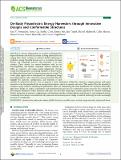
| dc.description.abstract | Recent advancements in wearable technology have improved lifestyle and medical practices, enabling personalized care ranging from fitness tracking, to real-time health monitoring, to predictive sensing. Wearable devices serve as an interface between humans and technology; however, this integration is far from seamless. These devices face various limitations such as size, biocompatibility, and battery constraints wherein batteries are bulky, are expensive, and require regular replacement. On-body energy harvesting presents a promising alternative to battery power by utilizing the human body's continuous generation of energy. This review paper begins with an investigation of contemporary energy harvesting methods, with a deep focus on piezoelectricity. We then highlight the materials, configurations, and structures of such methods for self-powered devices. Here, we propose a novel combination of thin-film composites, kirigami patterns, and auxetic structures to lay the groundwork for an integrated piezoelectric system to monitor and sense. This approach has the potential to maximize energy output by amplifying the piezoelectric effect and manipulating the strain distribution. As a departure from bulky, rigid device design, we explore compositions and microfabrication processes for conformable energy harvesters. We conclude by discussing the limitations of these harvesters and future directions that expand upon current applications for wearable technology. Further exploration of materials, configurations, and structures introduce interdisciplinary applications for such integrated systems. Considering these factors can revolutionize the production and consumption of energy as wearable technology becomes increasingly prevalent in everyday life. | en_US |
| dc.language.iso | en | |
| dc.publisher | American Chemical Society (ACS) | en_US |
| dc.relation.isversionof | 10.1021/ACSBIOMATERIALS.1C00800 | en_US |
| dc.rights | Creative Commons Attribution-Noncommercial-Share Alike | en_US |
| dc.rights.uri | http://creativecommons.org/licenses/by-nc-sa/4.0/ | en_US |
| dc.source | ACS | en_US |
| dc.title | On-Body Piezoelectric Energy Harvesters through Innovative Designs and Conformable Structures | en_US |
| dc.type | Article | en_US |
| dc.identifier.citation | Fernandez, Sara V, Cai, Fiona, Chen, Sophia, Suh, Emma, Tiepelt, Jan et al. 2021. "On-Body Piezoelectric Energy Harvesters through Innovative Designs and Conformable Structures." ACS Biomaterials Science & Engineering. | |
| dc.contributor.department | Program in Media Arts and Sciences (Massachusetts Institute of Technology) | en_US |
| dc.relation.journal | ACS Biomaterials Science & Engineering | en_US |
| dc.eprint.version | Author's final manuscript | en_US |
| dc.type.uri | http://purl.org/eprint/type/JournalArticle | en_US |
| eprint.status | http://purl.org/eprint/status/PeerReviewed | en_US |
| dc.date.updated | 2022-11-01T17:15:26Z | |
| dspace.orderedauthors | Fernandez, SV; Cai, F; Chen, S; Suh, E; Tiepelt, J; McIntosh, R; Marcus, C; Acosta, D; Mejorado, D; Dagdeviren, C | en_US |
| dspace.date.submission | 2022-11-01T17:15:30Z | |
| mit.license | OPEN_ACCESS_POLICY | |
| mit.metadata.status | Authority Work and Publication Information Needed | en_US |