| dc.contributor.author | Yang, Dian | |
| dc.contributor.author | Jones, Matthew G | |
| dc.contributor.author | Naranjo, Santiago | |
| dc.contributor.author | Rideout, William M | |
| dc.contributor.author | Min, Kyung Hoi Joseph | |
| dc.contributor.author | Ho, Raymond | |
| dc.contributor.author | Wu, Wei | |
| dc.contributor.author | Replogle, Joseph M | |
| dc.contributor.author | Page, Jennifer L | |
| dc.contributor.author | Quinn, Jeffrey J | |
| dc.contributor.author | Horns, Felix | |
| dc.contributor.author | Qiu, Xiaojie | |
| dc.contributor.author | Chen, Michael Z | |
| dc.contributor.author | Freed-Pastor, William A | |
| dc.contributor.author | McGinnis, Christopher S | |
| dc.contributor.author | Patterson, David M | |
| dc.contributor.author | Gartner, Zev J | |
| dc.contributor.author | Chow, Eric D | |
| dc.contributor.author | Bivona, Trever G | |
| dc.contributor.author | Chan, Michelle M | |
| dc.contributor.author | Yosef, Nir | |
| dc.contributor.author | Jacks, Tyler | |
| dc.contributor.author | Weissman, Jonathan S | |
| dc.date.accessioned | 2022-12-09T18:58:23Z | |
| dc.date.available | 2022-12-09T18:58:23Z | |
| dc.date.issued | 2022 | |
| dc.identifier.uri | https://hdl.handle.net/1721.1/146823 | |
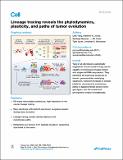
| dc.description.abstract | Tumor evolution is driven by the progressive acquisition of genetic and epigenetic alterations that enable uncontrolled growth and expansion to neighboring and distal tissues. The study of phylogenetic relationships between cancer cells provides key insights into these processes. Here, we introduced an evolving lineage-tracing system with a single-cell RNA-seq readout into a mouse model of Kras;Trp53(KP)-driven lung adenocarcinoma and tracked tumor evolution from single-transformed cells to metastatic tumors at unprecedented resolution. We found that the loss of the initial, stable alveolar-type2-like state was accompanied by a transient increase in plasticity. This was followed by the adoption of distinct transcriptional programs that enable rapid expansion and, ultimately, clonal sweep of stable subclones capable of metastasizing. Finally, tumors develop through stereotypical evolutionary trajectories, and perturbing additional tumor suppressors accelerates progression by creating novel trajectories. Our study elucidates the hierarchical nature of tumor evolution and, more broadly, enables in-depth studies of tumor progression. | en_US |
| dc.language.iso | en | |
| dc.publisher | Elsevier BV | en_US |
| dc.relation.isversionof | 10.1016/J.CELL.2022.04.015 | en_US |
| dc.rights | Creative Commons Attribution 4.0 International license | en_US |
| dc.rights.uri | https://creativecommons.org/licenses/by/4.0/ | en_US |
| dc.source | Elsevier | en_US |
| dc.title | Lineage tracing reveals the phylodynamics, plasticity, and paths of tumor evolution | en_US |
| dc.type | Article | en_US |
| dc.identifier.citation | Yang, Dian, Jones, Matthew G, Naranjo, Santiago, Rideout, William M, Min, Kyung Hoi Joseph et al. 2022. "Lineage tracing reveals the phylodynamics, plasticity, and paths of tumor evolution." Cell, 185 (11). | |
| dc.contributor.department | Massachusetts Institute of Technology. Department of Biology | en_US |
| dc.relation.journal | Cell | en_US |
| dc.eprint.version | Final published version | en_US |
| dc.type.uri | http://purl.org/eprint/type/JournalArticle | en_US |
| eprint.status | http://purl.org/eprint/status/PeerReviewed | en_US |
| dc.date.updated | 2022-12-09T18:50:02Z | |
| dspace.orderedauthors | Yang, D; Jones, MG; Naranjo, S; Rideout, WM; Min, KHJ; Ho, R; Wu, W; Replogle, JM; Page, JL; Quinn, JJ; Horns, F; Qiu, X; Chen, MZ; Freed-Pastor, WA; McGinnis, CS; Patterson, DM; Gartner, ZJ; Chow, ED; Bivona, TG; Chan, MM; Yosef, N; Jacks, T; Weissman, JS | en_US |
| dspace.date.submission | 2022-12-09T18:50:14Z | |
| mit.journal.volume | 185 | en_US |
| mit.journal.issue | 11 | en_US |
| mit.license | PUBLISHER_CC | |
| mit.metadata.status | Authority Work and Publication Information Needed | en_US |