| dc.contributor.author | Mendiratta, Mohit | |
| dc.contributor.author | Pan, Xingang | |
| dc.contributor.author | Elgharib, Mohamed | |
| dc.contributor.author | Teotia, Kartik | |
| dc.contributor.author | B R, Mallikarjun | |
| dc.contributor.author | Tewari, Ayush | |
| dc.contributor.author | Golyanik, Vladislav | |
| dc.contributor.author | Kortylewski, Adam | |
| dc.contributor.author | Theobalt, Christian | |
| dc.date.accessioned | 2024-01-04T14:04:55Z | |
| dc.date.available | 2024-01-04T14:04:55Z | |
| dc.date.issued | 2023-12-04 | |
| dc.identifier.issn | 0730-0301 | |
| dc.identifier.uri | https://hdl.handle.net/1721.1/153278 | |
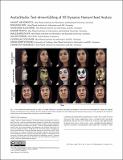
| dc.description.abstract | Capturing and editing full-head performances enables the creation of virtual characters with various applications such as extended reality and media production. The past few years witnessed a steep rise in the photorealism of human head avatars. Such avatars can be controlled through different input data modalities, including RGB, audio, depth, IMUs, and others. While these data modalities provide effective means of control, they mostly focus on editing the head movements such as the facial expressions, head pose, and/or camera viewpoint. In this paper, we propose AvatarStudio, a text-based method for editing the appearance of a dynamic full head avatar. Our approach builds on existing work to capture dynamic performances of human heads using Neural Radiance Field (NeRF) and edits this representation with a text-to-image diffusion model. Specifically, we introduce an optimization strategy for incorporating multiple keyframes representing different camera viewpoints and time stamps of a video performance into a single diffusion model. Using this personalized diffusion model, we edit the dynamic NeRF by introducing view-and-time-aware Score Distillation Sampling (VT-SDS) following a model-based guidance approach. Our method edits the full head in a canonical space and then propagates these edits to the remaining time steps via a pre-trained deformation network. We evaluate our method visually and numerically via a user study, and results show that our method outperforms existing approaches. Our experiments validate the design choices of our method and highlight that our edits are genuine, personalized, as well as 3D- and time-consistent. | en_US |
| dc.publisher | ACM | en_US |
| dc.relation.isversionof | https://doi.org/10.1145/3618368 | en_US |
| dc.rights | Creative Commons Attribution | en_US |
| dc.rights.uri | https://creativecommons.org/licenses/by/4.0/ | en_US |
| dc.source | Association for Computing Machinery | en_US |
| dc.title | AvatarStudio: Text-driven Editing of 3D Dynamic Human Head Avatars | en_US |
| dc.type | Article | en_US |
| dc.identifier.citation | Mendiratta, Mohit, Pan, Xingang, Elgharib, Mohamed, Teotia, Kartik, B R, Mallikarjun et al. 2023. "AvatarStudio: Text-driven Editing of 3D Dynamic Human Head Avatars." ACM Transactions on Graphics, 42 (6). | |
| dc.contributor.department | Massachusetts Institute of Technology. Computer Science and Artificial Intelligence Laboratory | |
| dc.relation.journal | ACM Transactions on Graphics | en_US |
| dc.identifier.mitlicense | PUBLISHER_CC | |
| dc.eprint.version | Final published version | en_US |
| dc.type.uri | http://purl.org/eprint/type/JournalArticle | en_US |
| eprint.status | http://purl.org/eprint/status/PeerReviewed | en_US |
| dc.date.updated | 2024-01-01T08:50:01Z | |
| dc.language.rfc3066 | en | |
| dc.rights.holder | The author(s) | |
| dspace.date.submission | 2024-01-01T08:50:02Z | |
| mit.journal.volume | 42 | en_US |
| mit.journal.issue | 6 | en_US |
| mit.license | PUBLISHER_CC | |
| mit.metadata.status | Authority Work and Publication Information Needed | en_US |