| dc.contributor.author | Belhe, Yash | |
| dc.contributor.author | Xu, Bing | |
| dc.contributor.author | Bangaru, Sai Praveen | |
| dc.contributor.author | Ramamoorthi, Ravi | |
| dc.contributor.author | Li, Tzu-Mao | |
| dc.date.accessioned | 2024-03-01T15:41:00Z | |
| dc.date.available | 2024-03-01T15:41:00Z | |
| dc.date.issued | 2024-02-21 | |
| dc.identifier.issn | 0730-0301 | |
| dc.identifier.issn | 1557-7368 | |
| dc.identifier.uri | https://hdl.handle.net/1721.1/153624 | |
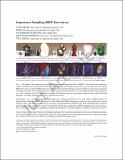
| dc.description.abstract | We propose a set of techniques to efficiently importance sample the derivatives of a wide range of BRDF models. In differentiable rendering, BRDFs are replaced by their differential BRDF counterparts which are real-valued and can have negative values. This leads to a new source of variance arising from their change in sign. Real-valued functions cannot be perfectly importance sampled by a positive-valued PDF, and the direct application of BRDF sampling leads to high variance. Previous attempts at antithetic sampling only addressed the derivative with the roughness parameter of isotropic microfacet BRDFs. Our work generalizes BRDF derivative sampling to anisotropic microfacet models, mixture BRDFs, Oren-Nayar, Hanrahan-Krueger, among other analytic BRDFs.
Our method first decomposes the real-valued differential BRDF into a sum of single-signed functions, eliminating variance from a change in sign. Next, we importance sample each of the resulting single-signed functions separately. The first decomposition, positivization, partitions the real-valued function based on its sign, and is effective at variance reduction when applicable. However, it requires analytic knowledge of the roots of the differential BRDF, and for it to be analytically integrable too. Our key insight is that the single-signed functions can have overlapping support, which significantly broadens the ways we can decompose a real-valued function. Our product and mixture decompositions exploit this property, and they allow us to support several BRDF derivatives that positivization could not handle. For a wide variety of BRDF derivatives, our method significantly reduces the variance (up to 58x in some cases) at equal computation cost and enables better recovery of spatially varying textures through gradient-descent-based inverse rendering. | en_US |
| dc.publisher | Association for Computing Machinery (ACM) | en_US |
| dc.relation.isversionof | 10.1145/3648611 | en_US |
| dc.rights | Creative Commons Attribution | en_US |
| dc.rights.uri | https://creativecommons.org/licenses/by/4.0/ | en_US |
| dc.source | Association for Computing Machinery | en_US |
| dc.subject | Computer Graphics and Computer-Aided Design | en_US |
| dc.title | Importance Sampling BRDF Derivatives | en_US |
| dc.type | Article | en_US |
| dc.identifier.citation | Belhe, Yash, Xu, Bing, Bangaru, Sai Praveen, Ramamoorthi, Ravi and Li, Tzu-Mao. 2024. "Importance Sampling BRDF Derivatives." ACM Transactions on Graphics. | |
| dc.contributor.department | Massachusetts Institute of Technology. Computer Science and Artificial Intelligence Laboratory | |
| dc.relation.journal | ACM Transactions on Graphics | en_US |
| dc.identifier.mitlicense | PUBLISHER_CC | |
| dc.eprint.version | Final published version | en_US |
| dc.type.uri | http://purl.org/eprint/type/JournalArticle | en_US |
| eprint.status | http://purl.org/eprint/status/PeerReviewed | en_US |
| dc.date.updated | 2024-03-01T08:45:19Z | |
| dc.language.rfc3066 | en | |
| dc.rights.holder | The author(s) | |
| dspace.date.submission | 2024-03-01T08:45:20Z | |
| mit.license | PUBLISHER_CC | |
| mit.metadata.status | Authority Work and Publication Information Needed | en_US |