| dc.contributor.author | Regev, Tamar I | |
| dc.contributor.author | Lipkin, Benjamin | |
| dc.contributor.author | Boebinger, Dana | |
| dc.contributor.author | Paunov, Alexander | |
| dc.contributor.author | Kean, Hope | |
| dc.contributor.author | Norman-Haignere, Sam V | |
| dc.contributor.author | Fedorenko, Evelina | |
| dc.date.accessioned | 2024-12-03T17:28:18Z | |
| dc.date.available | 2024-12-03T17:28:18Z | |
| dc.date.issued | 2024-09 | |
| dc.identifier.uri | https://hdl.handle.net/1721.1/157742 | |
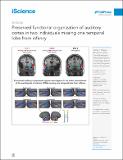
| dc.description.abstract | Human cortical responses to natural sounds, measured with fMRI, can be approximated as the weighted sum of a small number of canonical response patterns (components), each having interpretable functional and anatomical properties. Here, we asked whether this organization is preserved in cases where only one temporal lobe is available due to early brain damage by investigating a unique family: one sibling missing their left temporal lobe from infancy, another missing the right temporal lobe from infancy, and a third anatomically neurotypical. None of the siblings manifested behavioral deficits. We analyzed fMRI responses to diverse natural sounds within the intact hemispheres of these individuals and compared them to 12 neurotypical participants. All siblings manifested typical-like auditory responses in their intact hemispheres. These results suggest that the development of the auditory cortex in each hemisphere does not depend on the existence of the other hemisphere, highlighting the redundancy and equipotentiality of the bilateral auditory system. | en_US |
| dc.language.iso | en | |
| dc.publisher | Elsevier BV | en_US |
| dc.relation.isversionof | 10.1016/j.isci.2024.110548 | en_US |
| dc.rights | Creative Commons Attribution-NonCommercial-NoDerivs | en_US |
| dc.rights.uri | https://creativecommons.org/licenses/by-nc-nd/4.0/ | en_US |
| dc.source | Elsevier | en_US |
| dc.title | Preserved functional organization of auditory cortex in two individuals missing one temporal lobe from infancy | en_US |
| dc.type | Article | en_US |
| dc.identifier.citation | Regev, Tamar I. et al. Preserved functional organization of auditory cortex in two individuals missing one temporal lobe from infancy. iScience, Volume 27, Issue 9, 110548 | en_US |
| dc.contributor.department | Massachusetts Institute of Technology. Department of Brain and Cognitive Sciences | en_US |
| dc.contributor.department | McGovern Institute for Brain Research at MIT | en_US |
| dc.relation.journal | iScience | en_US |
| dc.eprint.version | Final published version | en_US |
| dc.type.uri | http://purl.org/eprint/type/JournalArticle | en_US |
| eprint.status | http://purl.org/eprint/status/PeerReviewed | en_US |
| dc.date.updated | 2024-12-03T17:18:47Z | |
| dspace.orderedauthors | Regev, TI; Lipkin, B; Boebinger, D; Paunov, A; Kean, H; Norman-Haignere, SV; Fedorenko, E | en_US |
| dspace.date.submission | 2024-12-03T17:18:49Z | |
| mit.journal.volume | 27 | en_US |
| mit.journal.issue | 9 | en_US |
| mit.license | PUBLISHER_CC | |
| mit.metadata.status | Authority Work and Publication Information Needed | en_US |