

Antigen presentation dynamics shape the antibody response to variants like SARS-CoV-2 Omicron after multiple vaccinations with the original strain
DownloadPublished version (5.431Mb)
Publisher with Creative Commons License
Publisher with Creative Commons License
Creative Commons Attribution
Terms of use
Metadata
Show full item recordAbstract
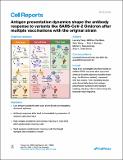
The Omicron variant of SARS-CoV-2 is not effectively neutralized by most antibodies elicited by two doses of mRNA vaccines, but a third dose increases anti-Omicron neutralizing antibodies. We reveal mechanisms underlying this observation by combining computational modeling with data from vaccinated humans. After the first dose, limited antigen availability in germinal centers (GCs) results in a response dominated by B cells that target immunodominant epitopes that are mutated in an Omicron-like variant. After the second dose, these memory cells expand and differentiate into plasma cells that secrete antibodies that are thus ineffective for such variants. However, these pre-existing antigen-specific antibodies transport antigen efficiently to secondary GCs. They also partially mask immunodominant epitopes. Enhanced antigen availability and epitope masking in secondary GCs together result in generation of memory B cells that target subdominant epitopes that are less mutated in Omicron. The third dose expands these cells and boosts anti-variant neutralizing antibodies.
Date issued
2023-04Department
Massachusetts Institute of Technology. Department of Chemical Engineering; Massachusetts Institute of Technology. Department of Physics; Massachusetts Institute of Technology. Department of Chemistry; Massachusetts Institute of Technology. Institute for Medical Engineering & Science; Ragon Institute of MGH, MIT and HarvardJournal
Cell Reports
Publisher
Elsevier BV
Citation
Yang, Leerang, Van Beek, Matthew, Wang, Zijun, Muecksch, Frauke, Canis, Marie et al. 2023. "Antigen presentation dynamics shape the antibody response to variants like SARS-CoV-2 Omicron after multiple vaccinations with the original strain." Cell Reports, 42 (4).
Version: Final published version