| dc.contributor.author | Yang, Leerang | |
| dc.contributor.author | Caradonna, Timothy M | |
| dc.contributor.author | Schmidt, Aaron G | |
| dc.contributor.author | Chakraborty, Arup K | |
| dc.date.accessioned | 2024-12-09T20:50:06Z | |
| dc.date.available | 2024-12-09T20:50:06Z | |
| dc.date.issued | 2023-03 | |
| dc.identifier.uri | https://hdl.handle.net/1721.1/157801 | |
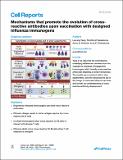
| dc.description.abstract | Immunogens that elicit broadly neutralizing antibodies targeting the conserved receptor-binding site (RBS) on influenza hemagglutinin may serve as candidates for a universal influenza vaccine. Here, we develop a computational model to interrogate antibody evolution by affinity maturation after immunization with two types of immunogens: a heterotrimeric "chimera" hemagglutinin that is enriched for the RBS epitope relative to other B cell epitopes and a cocktail composed of three non-epitope-enriched homotrimers of the monomers that comprise the chimera. Experiments in mice find that the chimera outperforms the cocktail for eliciting RBS-directed antibodies. We show that this result follows from an interplay between how B cells engage these antigens and interact with diverse helper T cells and requires T cell-mediated selection of germinal center B cells to be a stringent constraint. Our results shed light on antibody evolution and highlight how immunogen design and T cells modulate vaccination outcomes. | en_US |
| dc.language.iso | en | |
| dc.publisher | Elsevier BV | en_US |
| dc.relation.isversionof | 10.1016/j.celrep.2023.112160 | en_US |
| dc.rights | Creative Commons Attribution-NonCommercial-NoDerivs License | en_US |
| dc.rights.uri | https://creativecommons.org/licenses/by-nc-nd/4.0/ | en_US |
| dc.source | Elsevier BV | en_US |
| dc.title | Mechanisms that promote the evolution of cross-reactive antibodies upon vaccination with designed influenza immunogens | en_US |
| dc.type | Article | en_US |
| dc.identifier.citation | Yang, Leerang, Caradonna, Timothy M, Schmidt, Aaron G and Chakraborty, Arup K. 2023. "Mechanisms that promote the evolution of cross-reactive antibodies upon vaccination with designed influenza immunogens." Cell Reports, 42 (3). | |
| dc.contributor.department | Massachusetts Institute of Technology. Department of Chemical Engineering | en_US |
| dc.contributor.department | Ragon Institute of MGH, MIT and Harvard | en_US |
| dc.contributor.department | Massachusetts Institute of Technology. Department of Physics | en_US |
| dc.contributor.department | Massachusetts Institute of Technology. Department of Chemistry | en_US |
| dc.contributor.department | Massachusetts Institute of Technology. Institute for Medical Engineering & Science | en_US |
| dc.relation.journal | Cell Reports | en_US |
| dc.eprint.version | Final published version | en_US |
| dc.type.uri | http://purl.org/eprint/type/JournalArticle | en_US |
| eprint.status | http://purl.org/eprint/status/PeerReviewed | en_US |
| dc.date.updated | 2024-12-09T20:42:10Z | |
| dspace.orderedauthors | Yang, L; Caradonna, TM; Schmidt, AG; Chakraborty, AK | en_US |
| dspace.date.submission | 2024-12-09T20:42:15Z | |
| mit.journal.volume | 42 | en_US |
| mit.journal.issue | 3 | en_US |
| mit.license | PUBLISHER_CC | |
| mit.metadata.status | Authority Work and Publication Information Needed | en_US |