| dc.contributor.author | Sun, Tiancheng | |
| dc.contributor.author | Xu, Zexiang | |
| dc.contributor.author | Zhang, Xiuming | |
| dc.contributor.author | Fanello, Sean | |
| dc.contributor.author | Rhemann, Christoph | |
| dc.contributor.author | Debevec, Paul | |
| dc.contributor.author | Tsai, Yun-Ta | |
| dc.contributor.author | Barron, Jonathan | |
| dc.contributor.author | Ramamoorthi, Ravi | |
| dc.date.accessioned | 2025-02-18T18:18:23Z | |
| dc.date.available | 2025-02-18T18:18:23Z | |
| dc.date.issued | 2020-11-26 | |
| dc.identifier.isbn | 978-1-4503-8107-9 | |
| dc.identifier.uri | https://hdl.handle.net/1721.1/158233 | |
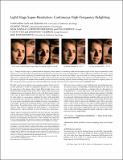
| dc.description.abstract | The light stage has been widely used in computer graphics for the past two decades, primarily to enable the relighting of human faces. By capturing the appearance of the human subject under different light sources, one obtains the light transport matrix of that subject, which enables image-based relighting in novel environments. However, due to the finite number of lights in the stage, the light transport matrix only represents a sparse sampling on the entire sphere. As a consequence, relighting the subject with a point light or a directional source that does not coincide exactly with one of the lights in the stage requires interpolation and resampling the images corresponding to nearby lights, and this leads to ghosting shadows, aliased specularities, and other artifacts. To ameliorate these artifacts and produce better results under arbitrary high-frequency lighting, this paper proposes a learning-based solution for the "super-resolution" of scans of human faces taken from a light stage. Given an arbitrary "query" light direction, our method aggregates the captured images corresponding to neighboring lights in the stage, and uses a neural network to synthesize a rendering of the face that appears to be illuminated by a "virtual" light source at the query location. This neural network must circumvent the inherent aliasing and regularity of the light stage data that was used for training, which we accomplish through the use of regularized traditional interpolation methods within our network. Our learned model is able to produce renderings for arbitrary light directions that exhibit realistic shadows and specular highlights, and is able to generalize across a wide variety of subjects. Our super-resolution approach enables more accurate renderings of human subjects under detailed environment maps, or the construction of simpler light stages that contain fewer light sources while still yielding comparable quality renderings as light stages with more densely sampled lights. | en_US |
| dc.publisher | Association for Computing Machinery | en_US |
| dc.relation.isversionof | https://doi.org/10.1145/3414685.3417821 | en_US |
| dc.rights | Article is made available in accordance with the publisher's policy and may be subject to US copyright law. Please refer to the publisher's site for terms of use. | en_US |
| dc.source | Association for Computing Machinery | en_US |
| dc.title | Light Stage Super-Resolution: Continuous High-Frequency Relighting | en_US |
| dc.type | Article | en_US |
| dc.identifier.citation | Sun, Tiancheng, Xu, Zexiang, Zhang, Xiuming, Fanello, Sean, Rhemann, Christoph et al. 2020. "Light Stage Super-Resolution: Continuous High-Frequency Relighting." ACM Transactions on Graphics, 39 (6). | |
| dc.contributor.department | Massachusetts Institute of Technology. Computer Science and Artificial Intelligence Laboratory | |
| dc.relation.journal | ACM Transactions on Graphics | en_US |
| dc.identifier.mitlicense | PUBLISHER_POLICY | |
| dc.eprint.version | Final published version | en_US |
| dc.type.uri | http://purl.org/eprint/type/JournalArticle | en_US |
| eprint.status | http://purl.org/eprint/status/PeerReviewed | en_US |
| dc.date.updated | 2025-02-01T08:50:23Z | |
| dc.language.rfc3066 | en | |
| dc.rights.holder | The author(s) | |
| dspace.date.submission | 2025-02-01T08:50:24Z | |
| mit.journal.volume | 39 | en_US |
| mit.journal.issue | 6 | en_US |
| mit.license | PUBLISHER_POLICY | |
| mit.metadata.status | Authority Work and Publication Information Needed | en_US |